Eight OSU-Developed Tomatoes To Try

CORVALLIS, Ore. – As you pore over seed catalogs in these cold winter months, you’ll likely include tomatoes in your vegetable garden dreams.

Oregon State University’s vegetable breeding program has developed several varieties over the past 40 years that are now mainstays in many Pacific Northwest gardens. Perhaps you know of Indigo Rose, the novelty purple tomato that OSU debuted in 2012. But did you know about the other varieties that the program has created?

In the past, the whole idea behind the breeding program has been to breed seedless types that are adapted to the cooler springs we have in Oregon and tomatoes with determinate growth so that they bloom earlier and set fruit under cooler conditions,” said Jim Myers, OSU’s vegetable breeder.

Under Myers’s leadership, the program has focused on two areas in recent years – developing varieties with late blight resistance and increasing phytonutrient potential.

“We try to build on the material previously developed in the vegetable breeding program,” Myers said.

Myers suggested the following OSU varieties, many of which were developed by his predecessor, Jim Baggett.

  • Legend: A tomato that produces large fruit that is good to eat straight off the vine. Resistant to some forms of late blight. Ripens 60-65 days after transplanting. You can get a larger-sized, earlier-ripening fruit by growing them first from seeds in gallon-size pots then transplanting them, Myers said.
  • Gold Nugget: Among the first to ripen, this prolific variety grows cherry tomatoes with a deep yellow color and mild, juicy flavor. Ripens in 60 days.
  • Oroma: This tomato makes good tomato sauce and paste. Early to mature; average ripening time of 70 days. Prolific after ripening. Fruit is meaty and thick-walled.
  • Oregon Spring: Ripens in 60-70 days. Slicing variety that can be eaten fresh in salads or straight from the vine. It will produce high, early yields of silver-dollar-sized juicy tomatoes.
  • Oregon Star: Ripens in 80 days. An early-maturing, red paste-type tomato. Large, seedless fruit. Good for fresh eating and for canning.
  • Santiam: Ripens in 65-75 days. Suited for salads and fresh eating; good, tart flavor.
  • Siletz: Ripens in 70-75 days. Reliable tomato with good flavor; ideal for eating fresh from the vine. Not resistant to late blight.
  • Indigo Rose: Ripens about 80-90 days after transplanting. First of a new class of tomato that is high in antioxidants. Its purple color comes from the anthocyanin pigment in its fruit. This open-pollinated variety is semi-determinate – or larger than a determinate type but smaller than indeterminate types – and a prolific producer. Get the best flavor by picking the tomato at its ripest; it will turn a muddy brown, dull purple color in September when ripe.

Find these tomatoes in the seed catalogs from Territorial Seed Co., Victory Seed Co., Ed Hume Seeds, Johnny’s Selected Seeds and Nichols Garden Nursery. 

Except for Indigo Rose, these tomatoes are determinate types, meaning that they are bushy in form and have fruit that sets on the bud at the tip of the stem, Myers said. They continue growth from side branches. All tomatoes from determinate type plants ripen in a concentrated period of time. Indeterminate tomatoes, on the other hand, will grow vigorously to heights of up to 12 feet and produce fruit until frost kills them.

If you’re overwhelmed by all the tomato choices and only have limited space, Myers has some advice.

“Find a few tomato varieties that work really well for you and use them as standbys, but reserve some space every year for experimental types that you want to try,” said Myers, the Baggett-Frazier Professor of Vegetable Breeding in OSU’s College of Agricultural Sciences.

By Denise Ruttan, denise.ruttan@oregonstate.edu, on Twitter at @OregonStateExt
Source: Jim Myers, myersja@hort.oregonstate.edu
This story is online at: http://bit.ly/OSU_Gardening2324

About Gardening News From the OSU Extension Service: The Extension Service provides a variety of gardening information on its website at http://extension.oregonstate.edu/community/gardening. Resources include gardening tips, videos, podcasts, monthly calendars of outdoor chores, how-to publications, information about the Master Gardener program, and a monthly emailed newsletter.

Horticultural Report: Ornamental Grasses

Ornamental grass species offer distinctive foliage and varying textures to blend and contrast with the more standard flowering perennials.

There are two types of grasses:  warm-season & cool-season. The warm-season grasses are mainly deciduous, growing from spring through summer, blooming in fall, & going dormant in winter.  Cool -season grasses are usually evergreen & start their growth in fall, flowering in spring and summer. Both types have their flower clusters atop slender stems which bend & flow in the wind making them an interesting feature in the garden.

Ornamental grasses also have two growth habits:  running & clumping. Running grasses multiply by spreading stolons or rhizomes, and can be invasive.  The clumping type is not invasive.

There are ornamental grasses for all light conditions & soil types, and many work as container plants.

Early spring is the best time to plant & divide, & cut back & tidy up clumps of dead leaves & flowering stems from the previous year.  When planting the grasses, work organic matter, compost, and a complete fertilizer into the soil, & plant the crown above the soil line to encourage drainage & prevent rot.
Carex buchananii - Leatherleaf Sedge-'Red Rooster'
Carex buchananii – Leatherleaf Sedge – ‘Red Rooster’
Light -full sun to part shade
Height – 18″ – 24″
Bloom – insignificant
Care – thrives in moist, rich soil
Featured uses – cool-season grass; narrow copper-bronze foliage; maintains color all year; upright-clumping form; ideal for containers
Other notes – Carex or Sedges are not true grasses, but their appearance is grass like.

Helictotrichon sempervirens – Blue Oat Grass
Light – full sun
Height – 2′ – 3′
Bloom – May – July; tan to cream flower spiked bloom on arching stems
Care – needs very well drained soil; feed in early spring with all purpose
fertilizer; comb out old growth Featured uses – cool-season grass; accent, borders, mass planting; semi evergreen perennial; stiff, clumping blue/gray to blue/green foliage

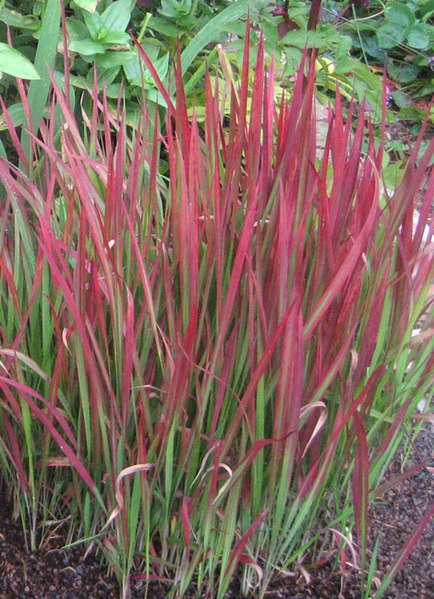
Imperata cylindrical – Japanese Blood Grass – ‘Rubra’
Light – sun or shade, but color is more intense if full sun or where
sunlight can shine through foliage
Height – 12″ – 24″
Bloom – none
Care – good soil & moderate watering
Featured uses – warm-season grass; moderate growing; clumping; deciduous; broadleaf foliage that is the most colorful of the grasses with the blood red color at the upper half of the blade

Pennisetum alopecuriodes – Dwarf Fountain Grass ‘Hameln’
Light – full sun
Height – 3′
Bloom – tan foxtail like flower plumes on slender stems rise above foliage from late summer into autumn
Care – average to good soil & regular watering Featured uses – warm-season grass; clumps of broadly arching foliage

Pennisetum setaceum – Fountain Grass – ‘Rubrum’
Light – full sun
Height – 2′ – 5′
Bloom – long plumes of dark rose colored flowers fading to beige from July to October
Care – drought tolerant
Featured uses – warm season grass; dense clump of bronzy, purplish red
foliage.

by: Viki Ashford

How to get rid of moss in your lawn

CORVALLIS, Ore. – With the rainy season in full swing, it’s time to count yourself in one of two camps: You either love or hate the moss that invades Pacific Northwest lawns.

But if moss is your nemesis every winter, there are some things you can do to combat this ancient plant, according to Alec Kowalewski, turfgrass specialist for the Oregon State University Extension Service. Moss is a sign of too much shade and wet soil conditions, he said.

“One of the best ways to control moss is to increase sunlight,” Kowalewski said. “If you have a shaded lawn, I would suggest pruning your trees to a height of six feet and keeping the branches open for sunlight. Decide whether it’s more important to you to have trees shading your lawn or a healthy stand of turfgrass. If turfgrass is a priority, thin the density of your trees to increase sunlight.”

If you don’t shine more light on your lawn, moss will come back every year no matter what other steps you take to control it, Kowalewski cautioned.

Consider improving the drainage of your lawn as well. Install a bioswale or rain garden to catch stormwater runoff, Kowalewski suggested. Water less frequently and more deeply during the hot days of summer. Don’t stress out your lawn either, he said: “Heal” your lawn to keep the moss at bay.

“Turfgrass, like all other living things, requires sunlight, water and air movement to photosynthesize and grow,” Kowalewski said. “If there’s a problem with any one of these three things, you can expect moss and weeds to invade your grass every year.”

Here’s one way to stress out your lawn: The more grass you remove when mowing your lawn, the more likely moss will invade, Kowalewski said. Grass mowed to a height of less than two inches will open the door for plant competition, he explained.

Fertilize your lawn with 2-4 pounds of nitrogen per 1,000 square feet two to four times per year in the spring and fall to increase the density of the grass and decrease the density of moss, Kowalewski said.

Additionally, several gardening products are available for moss control. Kowalewski recommends potassium soap as well as sulfate products such as ferrous sulfate, iron sulfate and ammonium sulfate. These are all non-synthetic, environmentally friendly options, he said. Apply by spot treating as soon as moss appears.

Sulfur products such as these will lower the soil pH, making conditions acidic – but turfgrass does not like acidic conditions, Kowalewski said. So an occasional application of lime, which will raise the pH, is recommended when you are making frequent sulfur applications, Kowalewski advised.

If you decide to use a synthetic pesticide, Kowalewski recommended that gardeners choose products with carfentrazone as an active ingredient. Read labels and follow all safety precautions when using pesticides.

“It’s not a long-term cure,” Kowalewski said. “If you applied pesticides or other moss control products but you did not improve your turfgrass density or sunlight exposure, moss is going to come back next year. The most important factors to improve are sunlight, water and air movement.”

Kowalewski holds the N.B. and Jacqueline Giustina Professorship in Turf Management within OSU’s College of Agricultural Sciences.

By Denise Ruttan,
Oregon State University Extension Service

To learn more, see the OSU Extension publication “Maintaining a Healthy Lawn in Western Oregon” at http://bit.ly/OSU_EC1521.

Source: Alec Kowalewski, alec.kowalewski@oregonstate.edu

Horticulture Report: November 2013

CalendulaPlants for Fall Color:
to name a few!

Click to view…

Report By Carlotta Lucas

Horticulture Report: May 2013

Rhododendrons & Azaleas
What’s the difference between Rhododendrons and azaleas?

Azaleas are Rhododendrons. They belong to the subgenus pentanthera (deciduous) and the subgenus Tsustusti (mostly evergreen).
Azaleas are elepidotes, they never have scales.
Azaleas have five lobes to the flower.
Most azaleas have only one stamen for each lobe of the flower, while most other rhododendrons have two stamens for each lobe.
Azaleas tend to have appressed hairs (hairs that grow parallel to the surface of the leaf). This is particularly true along the midrib of the under-surface of the leaf and is easily seen in the so called “evergreen” azaleas.
Azaleas have tubular funnel or funnel shaped flowers. You need a microscope to see this, but the hair on a “standard” rhododendron will often branch, while the hair on azaleas never does.

Basic Needs:
Rhododendrons must have a constant supply of moisture.
They are sensitive to poorly drained conditions.
Hot wet conditions are more dangerous than cool, wet conditions.
They need an acid soil of pH 5-6.
Fertilizer: A 10-6-4 formula is optimal. For the best growth and flowers apply fertilizer after the plant goes dormant between late Nov and Jan, a second application in Feb or March, a third time in April or May, and a final time in June or July.

Pruning:
Always prune right after flowering. Even large plants can be cut back. Rhododendrons & azaleas flower on the prior year’s wood, therefore the buds for next spring’s flowers form during the previous summer or fall. If you prune them later in the summer, fall or winter you will be trimming off your flowers for the spring.
Prune larger leaved rhododendrons just above the growth joints.
Prune azaleas and small leafed rhododendrons anywhere along the stem. These plants have dormant growth buds nearly everywhere, though you may not be able to see them.

Deadheading and Pinching:
Light pruning and shaping should be done yearly when you deadhead. Snap off the old flower trusses. You may pinch out the single terminal growth buds just as they start to grow. It will make a shorter and bushier plant.

For more information:
American Rhododendron Society
http://www.rhododendron.org/

American Azalea Society
http://azaleas.org/

Definitions:
Elepidotes are large leaved rhododendrons. They are the type of shrub that most individuals would associate as being a rhododendron. They do not have scales located on the underside of the leaves. Plants tend to be very large in their maturity.

Lepidote rhododendron have smaller leaves and are usually low growing or dwarfs. They usually bloom earlier in the spring than the larger leaved elepidotes. Tiny scales cover the undersides of the leaves of some rhododendron species.

Cool-Season Crops

Get a head start gardening in western Oregon with cool-season crops:

CORVALLIS, Ore. – Is this dry winter making you anxious to dig in the dirt again? There’s some good news if you garden in western Oregon and are an optimist.

Cool-season plants can be directly seeded into the ground in March in the Willamette Valley and southern Oregon , said Bob Reynolds, the Master Gardener coordinator for the Oregon State University Extension Service in Jackson and Josephine counties.

Cool-season crops include peas, arugula, carrots, cabbage, cilantro, fava beans, kale, kohlrabi, spinach, chard, turnips and lettuce.

Reynolds said he’s getting questions from the public already about when to start planting and how to tell when soil is ready.

“It depends on how experienced they are and how long they’ve lived here,” Reynolds said. “If they’ve lived here long, then they know a week of 60-degree days doesn’t mean spring is here. You may be anxious, but you hold yourself back.”

Reynolds recommends using a soil thermometer to check your soil temperature to decide whether to dig in. Soil rather than air temperature is the bellwether of whether to plant, he said. Seeds such as peas will germinate at an average soil temperature of about 50 degrees. Each species has different temperature requirements for germination. Generally, cool-season plants can survive air temperatures as cold as 28 degrees, Reynolds said.

Cover the new plantings with clear plastic to protect the soil from getting too saturated by rain.

Snow provides a nice incubator for new plants, acting as a blanket to keep the coldest air from penetrating, Reynolds said.

You can start hand weeding any time. Wait until plants have established themselves before fertilizing them.

As for gardeners in central and eastern Oregon , they’re going to have to be patient. Direct seeding for cool-season crops is not possible until late April or May, said Amy Jo Detweiler, an Extension horticulturist in Redmond . Seedlings can be transplanted in May and June.

“We tell people that March is a good time to clean and sharpen your garden tools and take care of your houseplants,” Detweiler said.

March is also a good time for high-desert gardeners to study seed catalogs and prepare seed tapes. Seed tapes are good for plants that require thinning, such as radishes. To make a seed tape, cut a 2- to 3- inch strip the length of a newspaper or use tissue paper strips, 2-3 inches wide and however long you need it, Detweiler said.

When it’s time to plant, bury the seed tapes in the soil at the seed appropriate depth and the tissue paper or newspaper will break down into the soil, Detweiler said.

By Denise Ruttan, Oregon State Extension
Source: Bob Reynolds, OSU & Amy Jo Detweiler, OSU
This article is online at http://bit.ly/OSU_Gardening2236