Garden of the Month: September 2013

The home at 340 Morton is currently owned by Betsy Wessler and the garden is at its peak in late summer.  Kaaren Anderson talked with Betsy last spring to gather a little history on the home and the lovely garden that surrounds it.
IMG_0092
The home was originally built in 1948 and was formerly owned by Dick and Evelyn Strellman.  Betsy purchased the home in 2007 with a move-in date of 2008.  Soon after, the house, as well as the entire yard, were renovated and redesigned.  Betsy’s former husband, Ian Wessler of Wessler Design Associates, worked with her to create the beautiful garden you see today.
 

IMG_0091The first major change was to move the driveway to the far right of the front yard from its former location closer to the house and entry way.  This gave a much broader area to reconstruct the garden.  The entrance to the garage, which originally faced the street, was reoriented to create a turnaround at the end of the new driveway.  Broken concrete pieces from the driveway were used to form walkways leading to the entry and around the house to the garage.IMG_0089

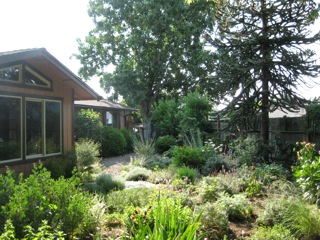
One challenge with the design involved mitigating a seepage problem located at the right rear of the front yard.  This was done by lowering the grade to create a gravel and rock lined dry creekbed, directing water through the front yard to a gated front vegetable garden.  As you will see, it is this creekbed that is beautifully lined with boulders and various tall grasses.  Winding back through these grasses one can find a Triflora maple, Zelkova and palm along with lilaIMG_0088c and wild currant.

Original rhubarb, quince and raspberries were kept and moved to various locations throughout the property.  Blueberries, Asian pear, persimmon and other fruit trees share the backyard with many of the original camellias.  

— Kaaren Anderson

Garden of the Month: August 2013

It’s tempting to suggest that you rush to see the front garden at 745 Park Street  immediately because the colors are so vivid right now and everything looks healthy and fresh. But it often looks great because it has been so well planned.
  IMG_0076 The homeowners have been serious about their gardens for 15 of the 17 years they have been in the house.  Initially, they had design and installation help in the back garden from Carol’s Colors.  In 2003 they met landscape designer Sharon Creek Siewert, whose practical and creative design ideas have transformed both the front and back.   Sharon ’s husband, Steve Siewert, also offers a variety of horticultural services.  Dubbed the “Tree Whisperer,” he saved the blue spruce in the front yard after it was blown over in a windstorm–among other significant contributions.  Kai Van Aken oversees garden management and weekly maintenance.
They have successfully screened the view of an apartment house over the back fence by planting Leland IMG_0075cypress, deodar cedars, and a giant sequoia, all of which are thriving, in a back area they call “the woods.”  Also in the back garden adjacent to the wood deck is a charming corner known as the Japanese garden with specimen rocks, a tiny stone bridge, azalea, and lacy Japanese maple.
 
 Flowers currently in bloom in front include roses, rudbeckia, heather,IMG_0073 gaura, penstemon, and salvia.  Other times of year, peonies, Dutch and Japanese iris, and lavender abound.  A crepe myrtle is on the verge of bursting forth.  When they moved in 17 years ago, the front garden was largely juniper.
IMG_0074In addition to the woods and Japanese garden in back, there is a lovely terraced area anchored by a large locust that shades the back deck and patio, plus dogwood, fig and apple trees.  Also rhododendrons, more roses, fuchsias, rosemary, gladiolas, erigeron, crocosmia, barberry, hostas, yarrow, photinia, and many more beautiful plants.  Annuals impatiens and snapdragons provide seasonal color.
 This garden is an unexpected treat in a dry (and this year smokey) month.
— Ruth Sloan
 

Garden Of the Month: July 2013

WE1As you walk along the Bear Creek Bike Path that goes between Walker Street and Normal Street, you will be intrigued by the cyclone fence that has many locks and keys attached to it. Further along there is a memorial made of shovels. Then you can peek into a lovely, serene and peaceful garden for meditation. Next, pass by a wooden fence covered in old snow skis. Now, if you are like me, you wonder who lives here?

 
WE2
Well, Wendy Eppinger lives here, at 190 Walker. She is a very artistic person who loves creating art from almost anything. She is also a dedicated gardener. She has spent years making her wonderful and interesting south-facing garden. Many trees…Monkey Pod, Variegated Box Elder, mulberry, maple, Douglas Fir, Santa Cruz Cypress, redwoods, an apricot and an apple shade her garden. In the front area are cottonwoods, a plum, a pear, a eucalyptus and an Incense Cedar filled with a collection of 34 decorative crows. Many of these trees were here when Wendy bought the property in 1993, and she added seven more.
 
WE4

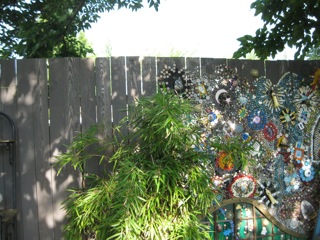
Be sure to notice her personalized window boxes, many ceramic and clay masks, and the large mosaic on the back fence that has a story that Wendy will tell you about.WE3

Her garden has many peonies, rhododendrons, wisteria and perennials such as Erysimum Bowle’s Mauve, alyssum and dahlias. Notice the planter barrels next to the house with cut metal vines and leaves. There is so much more for you to discover!

Wendy has been described by her daughter-in-law as “the most persistently creative person I have ever met. Creating for Wendy is like breathing for other people, and every inch of space reflects this.”

Wendy’s garden is a hidden treasure.
~Karen O’Rourke

*Wendy asked that we not put up our AGC sign honoring her garden.

Garden of the Month: June 2013

When Jan Christenson and Rick Ukena bought their house at 445 Thimbleberry in 2008, it was surrounded by lawn and a few trees.
IMG_0038Today, there’s no lawn, but there are 11 new trees (shantung maples and heritage birch, mugo pine, gingko, eucalyptus, yellowwood, perotia), shrubs (artemesia, lilac, elderberry, thimbleberry, smoke bush, cistus), flowers (helibore, peonies, wallflowers, gaura and gaillardia), many different ground covers, including mock strawberry, wild sunflowers, herbs, a small cactus garden, a small, deer-proof raised bed — even bonsai.
The wrap-around garden is accented by whimsical, custom-madeIMG_0050 pavers and garden goddesses, a delightful water feature, bird bath, rocks from various trips around the West, driftwood sculptures accented by antique metal objects, a mini dry riverbed, and meandering pathways. The lawn was used as a medium for creating berms surrounding the dry creek. All this on a corner lot that’s just .15 acres.
Tucked away from view are two small private gardens, one with a hot tub and 20- foot-tall Nordmann fir IMG_0039trees that doubles as a dog run. The patio garden off the kitchen includes raised vegetable beds, canna lilies, large pots with abelia and jade, a maple tree, and various potted flowering plants.
Jan designed the garden with Zack Williams of Regenesis, who created the hardscape. These days, Rick does most of the heavy digging, while Jan continues with design.
IMG_0043
Jan and Rick moved from Portland, where they had a huge double urban lot. “I must say, we so much enjoy managing a smaller landscape area,” says Jan.
 
You can see this garden any time at the corner of Thimbleberry and Starflower. On Friday, June 14, Jan will be on hand from 10-12 to show you the private gardens and answer any questions.
 
— Julia Sommer
 

Horticulture Report: May 2013

Rhododendrons & Azaleas
What’s the difference between Rhododendrons and azaleas?

Azaleas are Rhododendrons. They belong to the subgenus pentanthera (deciduous) and the subgenus Tsustusti (mostly evergreen).
Azaleas are elepidotes, they never have scales.
Azaleas have five lobes to the flower.
Most azaleas have only one stamen for each lobe of the flower, while most other rhododendrons have two stamens for each lobe.
Azaleas tend to have appressed hairs (hairs that grow parallel to the surface of the leaf). This is particularly true along the midrib of the under-surface of the leaf and is easily seen in the so called “evergreen” azaleas.
Azaleas have tubular funnel or funnel shaped flowers. You need a microscope to see this, but the hair on a “standard” rhododendron will often branch, while the hair on azaleas never does.

Basic Needs:
Rhododendrons must have a constant supply of moisture.
They are sensitive to poorly drained conditions.
Hot wet conditions are more dangerous than cool, wet conditions.
They need an acid soil of pH 5-6.
Fertilizer: A 10-6-4 formula is optimal. For the best growth and flowers apply fertilizer after the plant goes dormant between late Nov and Jan, a second application in Feb or March, a third time in April or May, and a final time in June or July.

Pruning:
Always prune right after flowering. Even large plants can be cut back. Rhododendrons & azaleas flower on the prior year’s wood, therefore the buds for next spring’s flowers form during the previous summer or fall. If you prune them later in the summer, fall or winter you will be trimming off your flowers for the spring.
Prune larger leaved rhododendrons just above the growth joints.
Prune azaleas and small leafed rhododendrons anywhere along the stem. These plants have dormant growth buds nearly everywhere, though you may not be able to see them.

Deadheading and Pinching:
Light pruning and shaping should be done yearly when you deadhead. Snap off the old flower trusses. You may pinch out the single terminal growth buds just as they start to grow. It will make a shorter and bushier plant.

For more information:
American Rhododendron Society
http://www.rhododendron.org/

American Azalea Society
http://azaleas.org/

Definitions:
Elepidotes are large leaved rhododendrons. They are the type of shrub that most individuals would associate as being a rhododendron. They do not have scales located on the underside of the leaves. Plants tend to be very large in their maturity.

Lepidote rhododendron have smaller leaves and are usually low growing or dwarfs. They usually bloom earlier in the spring than the larger leaved elepidotes. Tiny scales cover the undersides of the leaves of some rhododendron species.