Garden of the Month: June 2013
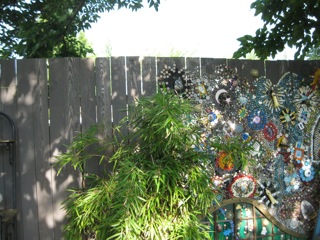
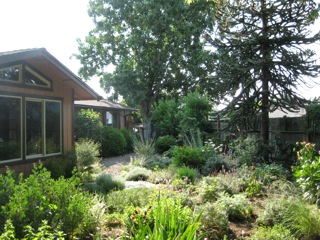
Today, there’s no lawn, but there are 11 new trees (shantung maples and heritage birch, mugo pine, gingko, eucalyptus, yellowwood, perotia), shrubs (artemesia, lilac, elderberry, thimbleberry, smoke bush, cistus), flowers (helibore, peonies, wallflowers, gaura and gaillardia), many different ground covers, including mock strawberry, wild sunflowers, herbs, a small cactus garden, a small, deer-proof raised bed — even bonsai.
pavers and garden goddesses, a delightful water feature, bird bath, rocks from various trips around the West, driftwood sculptures accented by antique metal objects, a mini dry riverbed, and meandering pathways. The lawn was used as a medium for creating berms surrounding the dry creek. All this on a corner lot that’s just .15 acres.
trees that doubles as a dog run. The patio garden off the kitchen includes raised vegetable beds, canna lilies, large pots with abelia and jade, a maple tree, and various potted flowering plants.
Nan Quick’s Travel Diary: Historic Charleston, SC
Horticulture Report: May 2013
Rhododendrons & Azaleas
What’s the difference between Rhododendrons and azaleas?
Azaleas are Rhododendrons. They belong to the subgenus pentanthera (deciduous) and the subgenus Tsustusti (mostly evergreen).
Azaleas are elepidotes, they never have scales.
Azaleas have five lobes to the flower.
Most azaleas have only one stamen for each lobe of the flower, while most other rhododendrons have two stamens for each lobe.
Azaleas tend to have appressed hairs (hairs that grow parallel to the surface of the leaf). This is particularly true along the midrib of the under-surface of the leaf and is easily seen in the so called “evergreen” azaleas.
Azaleas have tubular funnel or funnel shaped flowers. You need a microscope to see this, but the hair on a “standard” rhododendron will often branch, while the hair on azaleas never does.
Basic Needs:
Rhododendrons must have a constant supply of moisture.
They are sensitive to poorly drained conditions.
Hot wet conditions are more dangerous than cool, wet conditions.
They need an acid soil of pH 5-6.
Fertilizer: A 10-6-4 formula is optimal. For the best growth and flowers apply fertilizer after the plant goes dormant between late Nov and Jan, a second application in Feb or March, a third time in April or May, and a final time in June or July.
Pruning:
Always prune right after flowering. Even large plants can be cut back. Rhododendrons & azaleas flower on the prior year’s wood, therefore the buds for next spring’s flowers form during the previous summer or fall. If you prune them later in the summer, fall or winter you will be trimming off your flowers for the spring.
Prune larger leaved rhododendrons just above the growth joints.
Prune azaleas and small leafed rhododendrons anywhere along the stem. These plants have dormant growth buds nearly everywhere, though you may not be able to see them.
Deadheading and Pinching:
Light pruning and shaping should be done yearly when you deadhead. Snap off the old flower trusses. You may pinch out the single terminal growth buds just as they start to grow. It will make a shorter and bushier plant.
For more information:
American Rhododendron Society
http://www.rhododendron.org/
American Azalea Society
http://azaleas.org/
Definitions:
Elepidotes are large leaved rhododendrons. They are the type of shrub that most individuals would associate as being a rhododendron. They do not have scales located on the underside of the leaves. Plants tend to be very large in their maturity.
Lepidote rhododendron have smaller leaves and are usually low growing or dwarfs. They usually bloom earlier in the spring than the larger leaved elepidotes. Tiny scales cover the undersides of the leaves of some rhododendron species.
Garden of the Month: May 2013
The first thing you notice upon arriving at 1120 Prospect Street is the natural quality of the garden – simple, elegant plantings that look as if no one has fussed over them at all. But this garden has been 15 years in the making. At first a tangle of ivy and bushes, it has been transformed into one filled with rhododendrons and peonies that carpet the light-filled, woodsy property. A variety of trees, including Japanese maple, oak, blue spruce and deodara cedar, provide the shade that make this garden thrive. TID water is the only irrigation used to maintain the simple beauty.
Jonathan Warren, the current owner and creator of the garden, moved 15 years ago into the home formerly owned by the Cotton family. Built in 1948, it was the first home on the hill above the university from Siskiyou Boulevard. The garden fills two acres. In addition to the trees and the 245 rhododendrons and peonies, there are numerous cherry trees, lilacs, iris, an enclosed berry garden filled with 100-year-old transplanted raspberry plants, and an abundance of blueberries.
Looking beyond the garden, you’ll see a home that fits the property. Built in the style of Frank Lloyd Wright, it is constructed of clear red cedar. But the most prominent feature is a large boulder that lives both outside and inside the home, creating a small pond in the living room. Talking with Jonathan, there is an obvious sense that both the home and garden are well loved.
All are invited to drive by and view this property as the plants begin to bloom throughout the month of May. From Siskiyou Boulevard take S. Mountain Avenue to the top where it intersects Prospect. Number 1120 will be the garden in front of you. Don’t miss the street views from S. Mountain and Elkader after they dogleg around the property.
Enjoy!–Kaaren Anderson