Seeds to direct Sow in mid to late March: Peas, radishes, spinach, lettuce, kale, arugula, chard, carrots, beets, and parsnips. Also Plant: Onion sets, and perennial roots like asparagus, artichokes, and rhubarb.
Seeds to start indoors for May Transplanting:
Tomatoes & Peppers:Essential to start NOW for transplanting in mid-to-late May.
Brassicas:Broccoli, cabbage, kale, cauliflower, and Brussels sprouts.
Herbs:Basil, parsley and cilantro
Other vegetables :Celery, eggplants, and leeks
Potatoes:Buy seed potatoes, sprout (“chit”) them in a cool, dark place, then plant.
Fruit & Berry Crops
Planting:March is ideal for planting fruit trees, strawberries, and cane-berries (raspberries and blackberries).
Pruning:Finish pruning fruit trees (apples, pears, cherries, peaches) before buds swell.
Fertilizing:Feed raspberries and blueberries with organic, acidic fertilizer.
Flower Beds & Landscaping
Clean & Mulch:Clear away dead foliage, apply compost, and mulch beds to suppress weeds.
Divide Perennials:Divide and transplant summer-blooming perennials.
Bulbs:Plant dahlia, lily, and gladiola tubers.
Pruning:Prune winter-flowering shrubs after they bloom and ornamental grasses.
Maintenance & Pests
Slug Control:Actively monitor and manage slugs using baits like Sluggo or traps, as they love new spring growth.
Soil Care:Avoid walking on or tilling heavy, wet, or saturated soil to prevent compaction.
Fertilizing:Apply fertilizer to evergreen shrubs (rhododendrons, azaleas) and roses.
Lawns:Sharpen mower blades and set the mower height to 1.5–2.5 inches. Apply Lime to increase alkalinity, boost nutrient uptake. Treat lawn for moss with ferrous sulfate (iron sulfate).
At dawn the gardens at 837 Glendower lie in serene splendor, the curved pathways empty. But soon daybreak will bring the first ray of sunshine illuminating a water droplet suspended on a spider web, a petal unfurling in the warmth, a butterfly weaving between the flowers, a bumblebee tumbling in the pollen, a tabby strutting down the path. A virtual metropolis of activity.
Watch for Neena’s fluffy canine peering through the window keeping an eye out for deer. Photo by Elizabeth Essex1
It’s hard to imagine but when Neena Barreto purchased the property in 2021 the ground was choked with crab grass and a single row of maples bordered the street. Due to their invasive root system and because their limbs encroached upon the power lines, Neena decided to have them removed by the City providing her with multiple opportunities for garden design.
Slowly a vision took shape and berms were created sheltering the residence from street traffic and adding privacy for the small patio where hot chai might be served on a cool morning. Pathways wind their way through the beds and around the corner to include the side yard bordering Tudor Street. Large flat-topped boulders were thoughtfully sited to take advantage of their view lines. At sunset Neena enjoys a view of Mount Ashland.
The maples were replaced with trees of a smaller stature including dwarf, slow growing Bosnian Pine (Pinus leucodermis) and Weeping Norway Spruce (Picea abies ‘pendula’) which anchor the raised beds. These are interspersed with Eastern Redbud (Cercis canadensis) and Persian Ironwood (Parrotia persica). A pair of Japanese Maples mark the front entry and Sawtooth Zelkova (Zelkova serrata) stand on either side of the driveway. These deciduous selections ensure a spectacular display of fall color.
The Persian Parrotia’s intriguing form offers fabulous foliage from spring through fall. Photo by Elizabeth Essex
Neena had moved to Oregon in 2019 with virtually no plant background but as a hiker she started paying attention to what grew and thrived here. Manzanita had always been one of her favorites. She already knew that her goal was to incorporate as many native, fire-wise and low maintenance plants as possible. Hence it was only natural for Neena to seek out Plant Oregon. Working with David Bish and Jenny Black, Neena expanded her plant selection to include specimens that provided year-round nectar and pollen for butterflies, moths, bees, wasps and hummingbirds. She was also advised to have a range of flower colors, shapes and sizes.
Broad-leafed evergreen shrubs include Neena’s favorite Manzanita together with Mahonia and Garrya (both Coastal and Fremonts). A fig tree, flannel bush (Fremontodendron californicaum), a butterfly bush (Buddleia spp.) and a stunning Blue Elderberry (Sambucus mexicana) are deciduous accents. Evergreen ground cover including Creeping Rosemary (Rosmarinus prostratus), Nandina, and Heather (Erica ‘King George) and several ornamental grasses are set out throughout the raised beds ensuring visual interest after the perennials have been pruned back for the winter.
Blue Elderberry showcases creamy white flowers in the spring and blue black berries in the fall.
On a recent visit it was evident from the industrious activity of butterflies and bees that the variety of perennials planted was to their liking! Purple and red salvias, blue rosemary, penstemon and calamintha, yellow Oregon Sunshine (Eriophyllum lanatum), orange and lavender hyssop (Agastache aurantiaca), California fuchsia (Zauschneria or Epilobium canum) all provide a virtual feast for pollinators on their journey. Their thirst satiated by a sip from a glass water dish.
Multiple Weeping Norway Spruce are featured in the garden. Photo by Elizabeth Essex
Altogether, the placement of trees, shrubs and perennials creates a pleasing rhythm of textures, colors and shapes. Even more significant perhaps is that already three generations have become integral to this story. Both Neena’s parents have added items of interest to the landscape and graduation pictures with her three sons were recently taken with the garden as a backdrop. Neena says that creating and maintaining her garden has brought her new found joy. It is a natural expression of who she is and her love of the natural world is evident for any passerby to enjoy.
Neena and her father enjoy a time-out together in the garden. Photo by Antonio Barreto
Those seeking out the July 2025 Garden of the Month are encouraged to drive a little further down Glendower to the trailhead leading to the Ashland Pond where an extensive restoration project took place following the Almeda Fire in 2020. Native and riparian plant material was contributed by many local organizations, including Ashland Garden Club, and planted by Lomakatsi’s crew and inter-tribal workforce through a contract with The Freshwater Trust.
The Ashland Garden Club has been selecting Gardens of the Month from April through September since 2000. Nominations are gratefully received at aogardenclub@gmail.com. Check out the club’s website at ashlandorgardenclub.org for information on meeting times and places.
At the end of a cul-de-sac in Mountain Meadows is a charming and whimsical garden. The sign out front says Donna’s garden, and in the Spring,it is full of flowers and the occasional bunny. Donna Ritchie moved to Ashland in 2000 with her husband Dean. Originally, their home was on the slope towards the North of town, but in 2012, after Dean’s death, Donna moved to her current home at 825 Creek Stone Way in the Mountain Meadows community.
Donna, a retired English teacher, has always loved “pretty things.” When she first moved in, the garden was quite bland, with just a few shrubs in the front. Over time, Donna, with Denise Moffat, her garden helper, has planted lots of colorful perennials and bulbs. Even after our major snowfall in February, the front garden in late February was full of color. Primroses, miniature daffodils, crocus and violas were blooming aside the path and in shiny blue pots near the front porch. One of the most interesting plants, a dwarf iris, is an early bloomer. These irises, called Iris reticulata, are dark purple, with designs on their falls.
Beside colorful flowering perennials, and lavenders that bloom later, Donna has added a collection of bunnies, which perch here and there in the garden and on the porch. Donna says these are “bunnies”, not rabbits, because rabbits are what folks eat! These charming bunnies range in size from as large as a small child to as small as a mouse. Folks coming by to view the flowers should see if they can find the smaller bunnies, hidden amongst the plants.
Donna’s garden is irrigated during the hot months by drip irrigation and micro sprays. Plants in pots need to be hand watered. Donna is grateful for the rain, and even the snow, which has kept her plants watered this Spring.
Miriam Weissberg’s creativity and love of color shows throughout her garden at 2025 Green Meadows Way. This is the Ashland Garden Club’s Garden of the Month for September 2024.
Photo by Miriam Weissberg, August 2023
When Miriam and her late husband Rob first moved to the property in 2018, the front yard was mostly grass and the back yard was dominated by blank space for an above-ground pool that the previous owner removed. Miriam and Rob planned and gardened together until he passed away in 2023. Now Miriam does all the designing and fine-tuning in the garden.
Photo by Miriam Weissberg, August 2023
Carlos and Pam Maya do much of the routine maintenance and larger projects. Miriam estimates that among herself, Carlos and Pam, they spend an average of about 18 hours per month on the garden.
Photo by Ruth Sloan, August 2024
Although she has access to TID water, she doesn’t use it very much because she didn’t want to design a landscape that would be reliant on water that is available such a small fraction of the year. She figures that, with added hardscape and drought tolerant plants, she uses less water than was the case when they moved in. The zoned irrigation system employs about two-thirds drip lines.
Flower beds and walkways in the back yard replacing pool site. Photo by Ruth Sloan, August 2024
Deck stairs with edging for safety, painted and photo by Miriam Weissberg. June 2019
Miriam’s advice to other gardeners is to try different things and see what works best given the many factors in your garden. Also, to encourage maximum blooming, keep your plants well pruned.
Photo by Miriam Weissberg, October 2023
Among her favorite plants are verbena and roses. In the recent past, she has planted many annuals, including beloved zinnias, to add color with the knowledge that her choices don’t require much water. This year, she didn’t have time to plant her usual annuals but the garden is still lovely.
Photo by Ruth Sloan, August 2024
Article by Ruth Sloan, AGC Garden of the Month With thanks to Marilyn Love for bringing this garden to my attention.
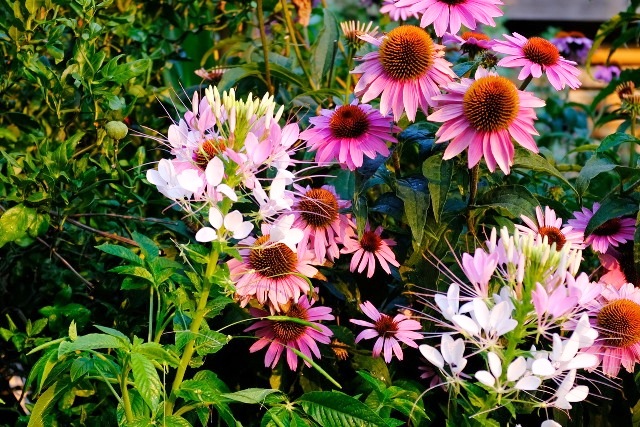
Cleome, peonies, and Japanese maples line the walkway to the front door. Photo by Tim MacCurdy
Tim MacCurdy started gardening at 600 Liberty St in 2018 and this is now the Ashland Garden Club’s Garden of the Month for August 2024. He lives here with his wife, Tricia, and son, Luca. When they first purchased the house there was little in the yard except a few trees. Now it is dense with food and ornamentals.
Cleome and echinacea, with yuzu in the background. Photo by Tim MacCurdy.
Tim has had an interest in gardening since he was a child, growing up in Atascadero California where his father inspired hard work on the family acreage. A kindergarten teacher, whose husband was on the botany faculty at Cal Poly, also encouraged Tim’s interest in plants to the point where Tim was known as the “flower boy” to other students and their families. Later Tim earned a degree at UC Berkeley in environmental sciences. When he was newly graduated, he started his own business tending other people’s gardens.
Lavender and bee balm by the mailboxes. Photo by Tim MacCurdy.
After world-wide travels he settled in Japan where, once again, his interest in plants and gardens was piqued although his primary concentration at that time was photography. He has plants now that are generations later of seeds he collected in Japan. Since his professional gardening days, he has gone on to pursue a career in medicine and now practices dermatology.
Peonies and ceanothus bloom along the walkway in May. Photo by Tim MacCurdy.
Tim does all the work himself in this garden. He estimates he averages two hours per day—more from May through September—in the garden and considers his plants (soil and structure) as part of his extended family.
The back yard is steeply sloped. Fruit trees, including persimmon, Asian pears, plums, olives, figs, and yuzu are dotted throughout the property. Among his favorite plants are cleome, nicotiana, echinacea, ginkgo, persimmons, and Japanese maples (some from seeds collected in Japan). Trees of all kinds have traveled with Tim and his family to homes in different parts of the western states.
Hachiya persimmons hang from the house rafters to dry when the MacCurdys first bought the house. Photo by Tim MacCurdy.
Given current climate conditions, Tim encourages gardeners to lean toward drought-tolerant plants. You should find “clues from your environment” and love your plants. He also suggests that you don’t always have to follow the rules of gardening and garden design, but instead you “should make your own rules.” He says, “engage with your garden, truly engage. Dedicate yourself to knowledge and spirit, and become an expert.”
Cleome and purple Shiso. Photo by Tim MacCurdy.
Article by Ruth Sloan, AGC Garden of the Month Chair
Mary Kyman’s beautiful garden at 1160 Bellview Ave. is the Ashland Garden Club’s Garden of the Month for July 2024. She started gardening here in 2009. Her garden was on the AUUW Garden Tour in 2014 and it was gorgeous at the time, but she has made many changes and improvements since then.
Mary does all the planning and design work. For many years, she did much of the physical labor as well, but has now turned over the day-to-day maintenance to Molly McConnell and her crew from Bee Kind Gardening. Nevertheless Mary estimates she spends about five hours a week on the garden and continues to be fully involved.
She has to be fully conscious of deer preferences in her plant selections and placement. The back yard is not accessible to those pesky intruders.
The prolific hydrangeas that line the front of the house on the west side are at the height of their glory this month. But many other plants, including rudbeckia, calla lilies, and hotlips salvia are also in their prime right now and these are among her favorite plants.
Both the house and the garden are art-filled. There is a stepping stone and gravel spiral in the front yard.
The garden in back has many fruit trees and berry plants. Raised beds harbor vegetables and herbs. An enormous elm, with fabulous bark, shades a good portion of the patio and back garden.
Mary has kindly suggested that those pedestrians who wish to see the front yard in its entirety, since a hedge blocks much of the view, can walk up the driveway but are asked to stay on the driveway itself.
Article and Photos by Ruth Sloan, AGC GoM Coordinator