All- My latest garden tour article has just been published.
Here’s the link–
Nan Quick
Nan Quick’s Diaries for Armchair Travelers
Check out Heirloom Garden
We enjoyed reading John Darling’s Feb. 2 [Daily Tidings] story about the soon-to-open Ashland Creek Park and his mention of the many other Ashland parks adopted by other community organizations and individuals. I’d like to add one other community garden to that list, which is the Heirloom Garden at North Mountain Park.
Inspired by gardens from the late 1800s, this particular garden was largely designed by Ashland Garden Club members in the late 1990s, and is solely maintained year-round by our members. According to Linda Chesney, Stewardship Coordinator at North Mountain Park, “The Heirloom Garden is really the front door of the entire park as its entrance is right on the Mountain Avenue entrance.”
Like other service organizations, AGC serves our community in other ways, including but not limited to the following:
- At club meetings from October to May, we offer free programs open to the public about various aspects of gardening.
- We fund both a high school and SOU scholarship (with money raised from our annual plant sale in May).
- We do all floral arrangements for the annual Feast of Will (with all flowers donated by club members from their gardens).
- We participate in gardening and environmental programs at the regional, state and national levels.
Anyone wanting more information can check out our website at www.ashlandorgardenclub.org. And we’re always looking for new members!
Susan Zane, President
Ashland Garden ClubPublished in the Daily Tidings 2/10/2015
 As you walk along the Bear Creek Bike Path that goes between Walker Street and Normal Street, you will be intrigued by the cyclone fence that has many locks and keys attached to it. Further along there is a memorial made of shovels. Then you can peek into a lovely, serene and peaceful garden for meditation. Next, pass by a wooden fence covered in old snow skis. Now, if you are like me, you wonder who lives here?
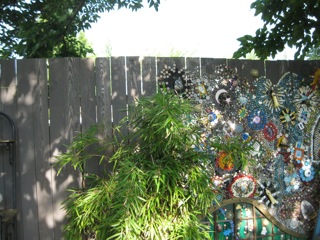

Be sure to notice her personalized window boxes, many ceramic and clay masks, and the large mosaic on the back fence that has a story that Wendy will tell you about.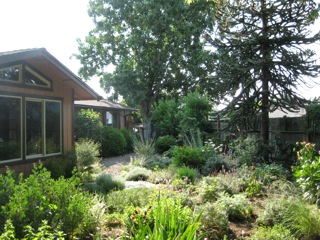
Her garden has many peonies, rhododendrons, wisteria and perennials such as Erysimum Bowle’s Mauve, alyssum and dahlias. Notice the planter barrels next to the house with cut metal vines and leaves. There is so much more for you to discover!
Wendy has been described by her daughter-in-law as “the most persistently creative person I have ever met. Creating for Wendy is like breathing for other people, and every inch of space reflects this.”
Wendy’s garden is a hidden treasure.
~Karen O’Rourke
*Wendy asked that we not put up our AGC sign honoring her garden.
Seed Swap
At the North Mountain Park’s seed swap you can save money, grow plants adapted to our local climate and exchange information with other gardeners. It’s fun and simple—just bring seeds you’ve saved from your garden and some bags or envelopes for taking seeds with you. The Nature Center will also be selling low-cost seed, harvested at the park by volunteers.
Pre-registration is not required
AGES: All ages welcome
DAY: Tuesday
DATE: February 5th, 2013
TIME: 7—8pm
PLACE: North Mountain Park Nature Center
COST: Free
INSTRUCTOR: North Mountain Park Staff
The English writer Beverley Nichols wrote in his book Down the Garden Path, “We are in the depths of winter….my first winter at the cottage…and the first winter when I went mad.” Isn’t this the feeling all gardeners have in the middle of winter when snow blankets our landscape and we stare out our windows into our gardens dreaming of vibrant multicolored flowers overflowing in our flower beds, the sweet scent of flowers filling our noses, and the sun warming our backs, as we weed.
Mr. Nichols poetically expresses a gardener’s dilemma in winter time when he writes, “ The average gardener, in the cold dark days of December and January, sits by his fire, turning over the pages of seed catalogs, wondering what he should sow for the spring.”
Does this sound familiar?
He continues writing, “If he goes out into his garden at all, it is only for the sake of exercise. He puts on a coat, stamps up and down the frozen path, hardly deigns to glance at the black empty beds, turns in again”. He says after his first winter, when he went mad, he declared he would have flowers in the winter time, real flowers, to get him through the dark cold days of winter.His friends, and neighbors, told him this desire for winter flowers was insane, he stated, “perhaps it was”, but flowers he would have.
The following are a few of the winter flowers he grew to get him through until spring.
Winter Flowers
 Helleborus niger……. Christmas rose
The Christmas rose is a traditional cottage garden favorite. It bears its pure white flowers (which fades to pink) in the depths of winter. They should be planted in partial shade, preferably under deciduous trees, which gives them winter sunlight. Plant in fertile, well-draining moist soil and protect them from strong winter winds. Height 8” USDA Hardiness Zones 3 to 8
Galanthus ni valis……Common Snowdrops
The common snowdrop looks like three drops of milk hanging from a stem. It is a bulbous plant in the Amaryllis family. Most flower in winter, before the vernal equinox (March 21st in the N. Hemisphere), but certain species flower in early spring and late autumn. Some snowdrop species are threatened in their wild habitats, and in most countries it is now illegal to collect bulbs from the wild. Good for mass plantings.
Height: less than 6″ USDA Hardiness Zones 3 to 8

Galanthus elwesii…Giant Snowdrop
Giant clear white fragrant flowers with predominant green inner segments Blooms 6 weeks earlier than the common snowdrop. Woodland plant. Performs best in the shade and in rich well-drained soil. Height: 12” USDA Hardiness Zones 3 to  8
8
Jasminum nudiflorum…..Winter Jasmine
Winter Jasmine is known to be one of the earliest blooming plants in the landscape. The 1″-wide yellow blooms open in January to March prior to the leaves but, unlike most jasmines, are not fragrant. The trailing branches root where they contact bare soil. Fill in areas if you like or support with a trellis. Plant in full sun to partial sun, in well-drained soils. Height 15’ USDA Hardiness Zones 6 to 10

Hamamelis mollis……Chinese Witch hazel
This ornamental deciduous shrub is known for its strongly scented flowers. It flowers in late January or early February and produces spider-like flowers which are long lasting. Plant in full sun to partial shade in moist fertile acidic soils. Height 10-12 feet (slow growing) USDA Hardiness Zones 5 to 8
Lonopsidi um acaule…False diamond flower (aka: violet cress)
Violet cress is a low growing annual plant with tiny pale lilac flowers appearing in early spring smelling like honey. It is Ideal for rock walls and edging plants. They need partial to deep shade with moist well-drained soil. Violet cress has naturalized in California through self-seeding, but they are not native to the U.S.; the USDA considers it an escaped weed!
Height 3-4” USDA Hardiness Zone: 3 to 9
 Eranthis….….Winter aconite
Winter aconite i s a member of the butter-cup family. All parts of this plant are poisonous, although its acrid taste m akes poisoning a low risk. Winter aconite blooms in late January or early February and blankets the ground with small, sunny, yellow blooms. Plant in well drained hum us-rich soil. This plant dies down completely after spring. It’s a good companion with snowdrops. Self seeds.
Height 8” USDA Hardiness Zone: 4 to 9
Eranthis – “A butter cup field in January. That is what the aconite will do for you…”, Beverley Nichols, Down the Garden Path.
 Chimonanthus fragans……Wintersweet
Hard to find old-fashioned deciduous shrub, but worth the search. The buds form in the fall and grow larger with each warm winter’s day. It can take three to five years to reach bloom stage, but it’s attractive in all seasons with tapered leaves on arching branches, which turn clear yellow in the fall. Easy to grow. Plant in sun or part shade and where you can walk by and enjoy its perfume.
Height 8-10’ USDA Hardiness Zone: 7 to 9
“If they (Wintersweet) are cut in bud, they lasted (in a vase), with the discreet assistance of a tablet of aspirin,…. nearly a month. Their perfume was as sweet and delicate as anything you could desire.” Beverley Nichols, Down the Garden Path.

Crocus imperati…..Early crocus
Lilac flowers with outside of outer petals buff, marked with dark purple. A reliable bloomer. Blooms in December or January. Plant in well drained soil, in the sun. Height 6” USDA Hardiness zone: 3 to 8
Crocus sieberis…….Snow crocus
A small, very early spring blooming, crocus which naturalizes easily and is ideal for rock gardens, under trees and shrubs, borders, and large drifts. Colors vary from white, blue, mauve, purple, having areas of white, yellow, or orange in the throat. Plant in well drained soil.
Height 3-4” USDA Hardiness Zone: 3 to 8
Corylopsi s Spicata……Spike Winterhazel
Deciduous shrub with open, bushy, upright, spreading, picturesque branches. Flowers are clear yellow in 1 to 2″ drooping clusters blooms in later winter and early spring. Fragrant. New leaf growth is dark purple and matures to deep blue-green. Plant in sun to partial shade. Do not over water. Height 6-8’ USDA Hardiness Zone: 6 to 8

Daphne meszerum – February Daphne
February Daphne is a deciduous to semi-evergreen shrub. Vibrant lilac-purple, neon pink or white flowers bloom on naked twigs in February and have a deliciously potent fragrance . It has thin soft green leaves in the summer followed by brilliant scarlet berries in September. Unlike other Daphnes, D. meszerum likes more sun and summer irrigation. Plant in well drained porous soil. Height 3-4’ USDA Hardiness Zone:5 to 8
“…learn this by heart: “The Daphne mezereum loves it roots in the shade and its head in the sun….” B everley Nichols, Down the Garden Path
Daphne odora- Winter Daphne
Winter Daphne is a handsome evergreen plant with powerful fragrant flowers. Pink to deep red flowers displayed in nosegay-clusters at the end of its branches. Blooms from February through April. Daphne odora needs air around its roots so plant in humus-rich semi-porous soil. Prefers mid-afternoon shade. Height: 4’ USDA Hardiness Zone: 4 to 10, 12, 14-24
Lonicera fragrantissima …..Winter Honeysuckle
Winter Honeysuckle is a deciduous shrub, in the nor thern states. Its creamy-white flowers are borne on naked twigs in February and produce a sweet lemony fragrance. Budded branches will bloom in doors for winter bouquets. Height 8-10’ USDA Hardiness Zone: 5 to 9
Please note: The U.S. Forrest Service listed Lonicera fragrantissima as a persistent invasive thre at to native habitats, especially in the southern states region.
Sternbergia lutea…Winter Daffodil (aka: Fall daffodil)
Winter daffodils have vibrant yellow, crocus-like blooms. They require a sunny location with well-drained, humus-rich soil and wind protection. The bulb can develop bulb rot if planted in too moist of an area. It produces crocus-like leaves after flowering, which lasts through the winter. These bulbs are touted as hardy bulbs but they are native to warmer winter regions so they are really semi-hardy because they can be injured at temperatures below 28°F. Need winter protection: plant in pots then move indoors, or into a greenhouse, for the winter. Note: Do not plant in the drip line of trees. Height 6-10” USDA Hardiness Zone:5 to 9
Sternbergia lutea – “…though its petals may be frozen with impunity, and though it will stand any amount of wind…it hates being dribbled upon.” Beverley Nichols, Down the Garden Path
 Petasites fragrans….Winter Heliotrope
Winter heliotrope has lilac to pink flowers that smells like vanilla. It’s a garden-escaped wildflower due to seed propagation, difficult to control spreading. It flowers November through to February. Grows in warm climates. Height 6-8” USDA Hardiness Zone: 9 to 10
 Iris stylosa …Winter Iris
This little beardless dwarf iris is sometimes called the Algerian iris. It’s lavender-blue flowers has a lemony-vanilla aroma. Planting them against a sunny wall will lessen their exposure to winter cold and encourage early blooming. Plant in well drained soil and do not water in the summer when dormant. Height 6-9” USDA Hardiness Zone: 4 to 9
*Another late-winter Iris: Iris reticulate: Blooms in mid-February in shades of blue & purple. Height 3”-6”
Forsythia int ermedia…..Forsythia
A deciduous shrub with upright spreading branches. Vigorous grower. Blooms in early March though April with very showy yellow blooms lasting 2 to 3 weeks. Plant in full sun to partial shade. It is very adaptable to poor soils, but prefers moist, well-drained soils. Plant in full sun. Height 8-10’ USDA Hardiness Zone: 4 to 8

Erica carnea…..Winter Heath
A dwarf evergreen shrub native to the European Alps which persist even under the snow. It often blooms at Christmas (“Winter Beauty”). Flowers are borne individually on the stem in masses of bell-shaped blossoms. Colors range from creamy white, rich pink, to deep ruby red (“ Ruby Glow”). Plant in well drained humus-rich soil. It needs partial shade in hotter areas. Spreads to 3 feet, so give it room. Prune yearly to prevent “legginess”.
Height 12-18” USDA Hardiness Zone: 2 to 10
“They are adorable, these clumps of winter heather. Actually they seem to welcome the snow, for it enhances their sweet complexions.” Beverley Nichols, Down the Garden Path
By: Carlotta Lucas