Nan Quick’s Diaries for Armchair Travelers

All-
   The third in my series of articles about the Gardens & Estates of Kent, England has
just been published. This chapter covers much ground: Marc Chagall’s stained glass windows at the country church of Tudeley; Traditional Hop-Farming methods; the picturesque landscapes at Scotney Castle; the quiet charms of Pashley Manor; and the world-famous gardens at Sissinghurst Castle.
Here’s the link
~Nan Quick 
 Nan Quick’s Diaries for Armchair Travelers

Eight OSU-Developed Tomatoes To Try

CORVALLIS, Ore. – As you pore over seed catalogs in these cold winter months, you’ll likely include tomatoes in your vegetable garden dreams.

Oregon State University’s vegetable breeding program has developed several varieties over the past 40 years that are now mainstays in many Pacific Northwest gardens. Perhaps you know of Indigo Rose, the novelty purple tomato that OSU debuted in 2012. But did you know about the other varieties that the program has created?

In the past, the whole idea behind the breeding program has been to breed seedless types that are adapted to the cooler springs we have in Oregon and tomatoes with determinate growth so that they bloom earlier and set fruit under cooler conditions,” said Jim Myers, OSU’s vegetable breeder.

Under Myers’s leadership, the program has focused on two areas in recent years – developing varieties with late blight resistance and increasing phytonutrient potential.

“We try to build on the material previously developed in the vegetable breeding program,” Myers said.

Myers suggested the following OSU varieties, many of which were developed by his predecessor, Jim Baggett.

  • Legend: A tomato that produces large fruit that is good to eat straight off the vine. Resistant to some forms of late blight. Ripens 60-65 days after transplanting. You can get a larger-sized, earlier-ripening fruit by growing them first from seeds in gallon-size pots then transplanting them, Myers said.
  • Gold Nugget: Among the first to ripen, this prolific variety grows cherry tomatoes with a deep yellow color and mild, juicy flavor. Ripens in 60 days.
  • Oroma: This tomato makes good tomato sauce and paste. Early to mature; average ripening time of 70 days. Prolific after ripening. Fruit is meaty and thick-walled.
  • Oregon Spring: Ripens in 60-70 days. Slicing variety that can be eaten fresh in salads or straight from the vine. It will produce high, early yields of silver-dollar-sized juicy tomatoes.
  • Oregon Star: Ripens in 80 days. An early-maturing, red paste-type tomato. Large, seedless fruit. Good for fresh eating and for canning.
  • Santiam: Ripens in 65-75 days. Suited for salads and fresh eating; good, tart flavor.
  • Siletz: Ripens in 70-75 days. Reliable tomato with good flavor; ideal for eating fresh from the vine. Not resistant to late blight.
  • Indigo Rose: Ripens about 80-90 days after transplanting. First of a new class of tomato that is high in antioxidants. Its purple color comes from the anthocyanin pigment in its fruit. This open-pollinated variety is semi-determinate – or larger than a determinate type but smaller than indeterminate types – and a prolific producer. Get the best flavor by picking the tomato at its ripest; it will turn a muddy brown, dull purple color in September when ripe.

Find these tomatoes in the seed catalogs from Territorial Seed Co., Victory Seed Co., Ed Hume Seeds, Johnny’s Selected Seeds and Nichols Garden Nursery. 

Except for Indigo Rose, these tomatoes are determinate types, meaning that they are bushy in form and have fruit that sets on the bud at the tip of the stem, Myers said. They continue growth from side branches. All tomatoes from determinate type plants ripen in a concentrated period of time. Indeterminate tomatoes, on the other hand, will grow vigorously to heights of up to 12 feet and produce fruit until frost kills them.

If you’re overwhelmed by all the tomato choices and only have limited space, Myers has some advice.

“Find a few tomato varieties that work really well for you and use them as standbys, but reserve some space every year for experimental types that you want to try,” said Myers, the Baggett-Frazier Professor of Vegetable Breeding in OSU’s College of Agricultural Sciences.

By Denise Ruttan, denise.ruttan@oregonstate.edu, on Twitter at @OregonStateExt
Source: Jim Myers, myersja@hort.oregonstate.edu
This story is online at: http://bit.ly/OSU_Gardening2324

About Gardening News From the OSU Extension Service: The Extension Service provides a variety of gardening information on its website at http://extension.oregonstate.edu/community/gardening. Resources include gardening tips, videos, podcasts, monthly calendars of outdoor chores, how-to publications, information about the Master Gardener program, and a monthly emailed newsletter.

Horticultural Report: Ornamental Grasses

Ornamental grass species offer distinctive foliage and varying textures to blend and contrast with the more standard flowering perennials.

There are two types of grasses:  warm-season & cool-season. The warm-season grasses are mainly deciduous, growing from spring through summer, blooming in fall, & going dormant in winter.  Cool -season grasses are usually evergreen & start their growth in fall, flowering in spring and summer. Both types have their flower clusters atop slender stems which bend & flow in the wind making them an interesting feature in the garden.

Ornamental grasses also have two growth habits:  running & clumping. Running grasses multiply by spreading stolons or rhizomes, and can be invasive.  The clumping type is not invasive.

There are ornamental grasses for all light conditions & soil types, and many work as container plants.

Early spring is the best time to plant & divide, & cut back & tidy up clumps of dead leaves & flowering stems from the previous year.  When planting the grasses, work organic matter, compost, and a complete fertilizer into the soil, & plant the crown above the soil line to encourage drainage & prevent rot.
Carex buchananii - Leatherleaf Sedge-'Red Rooster'
Carex buchananii – Leatherleaf Sedge – ‘Red Rooster’
Light -full sun to part shade
Height – 18″ – 24″
Bloom – insignificant
Care – thrives in moist, rich soil
Featured uses – cool-season grass; narrow copper-bronze foliage; maintains color all year; upright-clumping form; ideal for containers
Other notes – Carex or Sedges are not true grasses, but their appearance is grass like.

Helictotrichon sempervirens – Blue Oat Grass
Light – full sun
Height – 2′ – 3′
Bloom – May – July; tan to cream flower spiked bloom on arching stems
Care – needs very well drained soil; feed in early spring with all purpose
fertilizer; comb out old growth Featured uses – cool-season grass; accent, borders, mass planting; semi evergreen perennial; stiff, clumping blue/gray to blue/green foliage

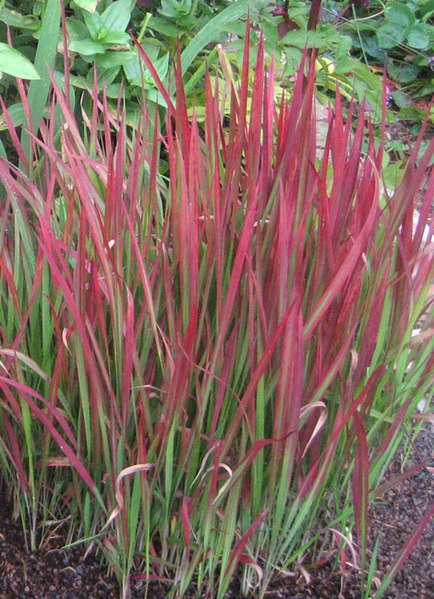
Imperata cylindrical – Japanese Blood Grass – ‘Rubra’
Light – sun or shade, but color is more intense if full sun or where
sunlight can shine through foliage
Height – 12″ – 24″
Bloom – none
Care – good soil & moderate watering
Featured uses – warm-season grass; moderate growing; clumping; deciduous; broadleaf foliage that is the most colorful of the grasses with the blood red color at the upper half of the blade

Pennisetum alopecuriodes – Dwarf Fountain Grass ‘Hameln’
Light – full sun
Height – 3′
Bloom – tan foxtail like flower plumes on slender stems rise above foliage from late summer into autumn
Care – average to good soil & regular watering Featured uses – warm-season grass; clumps of broadly arching foliage

Pennisetum setaceum – Fountain Grass – ‘Rubrum’
Light – full sun
Height – 2′ – 5′
Bloom – long plumes of dark rose colored flowers fading to beige from July to October
Care – drought tolerant
Featured uses – warm season grass; dense clump of bronzy, purplish red
foliage.

by: Viki Ashford

How to Attract Wild Birds to Your Yard this Winter

Oregon_Junco_

Oregon Junco

CORVALLIS, Ore. – Wild birds can sometimes use a little help from us to thrive in winter.

“In the springtime we focus on providing nesting sites and food for migratory birds, whereas in winter our winter residents and migratory birds still need food, shelter and water,” said Dana Sanchez, wildlife specialist for the Oregon State University Extension Service.

“These things are not found so easily in winter.”

Lesser gold finches, robins, juncos, chickadees, varied thrush and other species call Oregon home during the winter. They’re scrambling for what little there is to eat in the cold days – namely, insects, seeds, and berries.

“In addition to winter residents we get some altitudinal migrants,” Sanchez said. “When it’s warmer in the Willamette Valley than the higher elevations, we have birds that come down to the lower elevations to try to root arthropods out of the moss on tree branches and visit feeders. Some birds also eat the fruits of hawthorns and snowberries.”

During these frigid months, it is more important than ever for birds to conserve energy, Sanchez said. As humans keep a financial budget during leaner times, birds must maintain an “energy budget,” she said. Birds are limited in their ability to store excess fat because of their biological need to fly.

Oregonians can help birds by providing dense shrubbery or evergreens to serve as shelter from the weather and other challenges. Small birds, especially songbirds, need to find shelter quickly from raptors and other predators, Sanchez said. They also need shelter in close proximity to food so they don’t have to expend as much energy flying to find sustenance.

“Consider native plants because they are more adapted to conditions we have here in Oregon in the winter, and many are adapted to resist heavy deer damage,” Sanchez advised. “Choose shrubs that offer a perching structure.” Oregon grape is one good choice. Birds also look for insects to eat in leaf litter and under the moss and lichen that grows on shrubs.

Below are some additional tips to attract wild birds to your yard and to help them survive the long winter.

  • When choosing shrubs for your yard, include wildlife-related questions in your research. Some non-native shrubs produce berries and fruits that are acceptable to wildlife, but have fruits or berries that are toxic. For example, although long hailed as a wildlife-friendly landscaping shrub, berries of the Nandina species contain toxins that can harm birds or other animals.
  • Prevent water in birdbaths, hummingbird feeders and other dishes from freezing by rotating with fresh water throughout the day or covering it lightly.
  • Be sure to clean bird feeders regularly to prevent disease.
  • If you add a water feature such as a pond, “realize that other things could use that water, like raccoons and bullfrogs,” Sanchez said. “Providing habitat for native wildlife is really important but be careful about what comes uninvited.”
  • Offer a variety of feeders positioned at different heights and locations around your yard. Also provide a variety of feeds. The diversity will attract a variety of birds with different feeding habits.
  • Consider providing suet, a high-energy food for birds. Other good choices include specially designed feeders that offer black oil sunflower seeds or Nyjer thistle seed. Other birds will enjoy a standard style feeder that supplies a mix of seed types. Finally, some Anna’s hummingbirds now remain in the valley through winter. Feed them the standard mixture of dissolved sugar – four parts water to one part sugar. But keep an eye on nighttime temperatures. It might be necessary to bring your feeders in at night and set them out again each morning so that your hummers will have liquid food available.

For more information about wild birds, see the OSU Extension guides below.

About Gardening News From the OSU Extension Service:
The Extension Service provides a variety of gardening information on its website at http://extension.oregonstate.edu/community/gardening. Resources include gardening tips, videos, podcasts, monthly calendars of outdoor chores, how-to publications, information about the Master Gardener program, and a monthly emailed newsletter.

By Denise Ruttan, denise.ruttan@oregonstate.edu, on Twitter at @OregonStateExt
Source: Dana Sanchez,  Dana.Sanchez@oregonstate.edu
This story is also online at http://bit.ly/OSU_Gardening2314