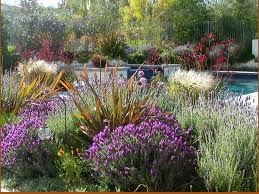
Garden of the Month: May 2011

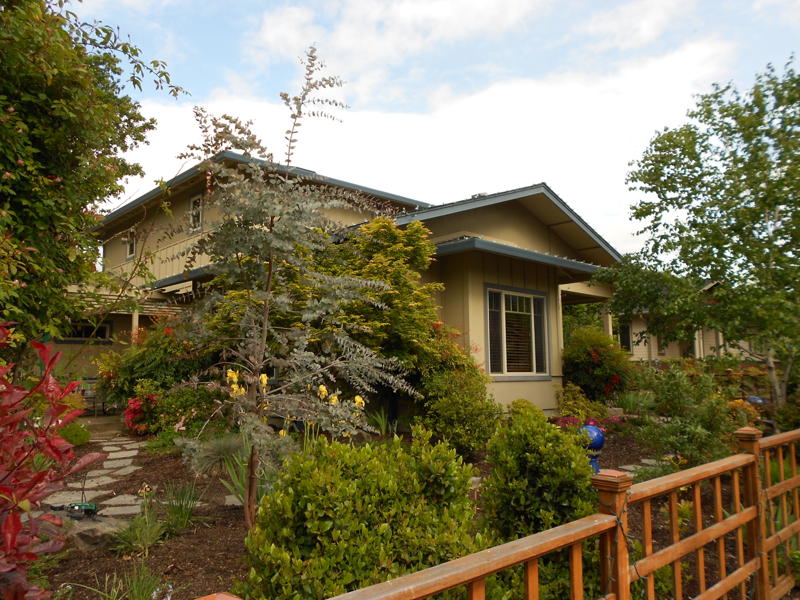
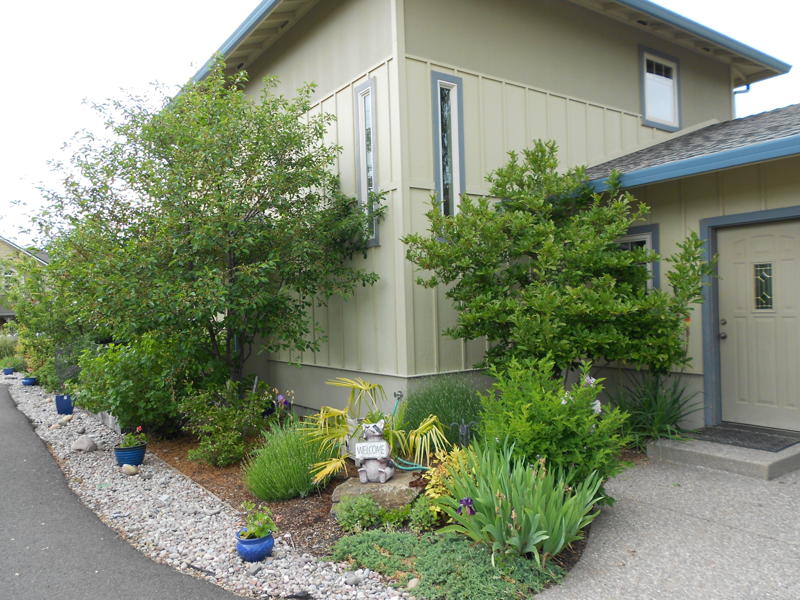
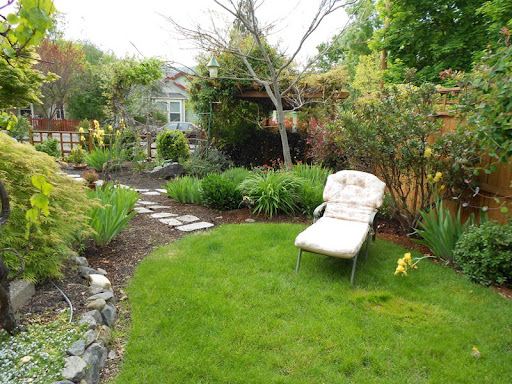
Winn Frankland’s beautiful garden at 122 High Street is a perfect spring garden, with
abundant flowers as well as buds and shoots appearing with the promise of more to
come. Frankland has gardened in this spot since coming to Ashland 16 years ago. She used to do all but the heaviest lifting herself, spending at least one hour a day. Now she has help in the garden four hours a week, while she practices Energy Medicine as developed by Donna Eden. Before coming to Ashland, she was a professional landscape designer in Chapel Hill, North Carolina, and transformed gardens in Tampa,
Florida.

Among the profusion of plants are many roses throughout the garden, including a hedge
of Simplicity roses and a climbing Peace rose which, at ten or eleven feet in height,
affords lovely views from a high deck and breakfast room. There are also David Austen roses and several Cecile Brunners.

Seeking equal-opportunity blessings for the garden, she has statuary of Buddha and
Saint Francis, and many smaller pieces, including a great frog who often wears a
charming hat of a blossom from the huge camellia nearby (the bush and its blossoms
are huge). There is a large tiered fountain in the back yard.

Frankland has custom-designed fences, screens, and gates—adapted from others she has seen—that allow views of the lovely garden, but keep the deer out. Because the crafty deer had discovered they could leap between the top of a gate and the bottom of an arbor that topped it, she designed a secondary section to the gate, creating an airy and clever Dutch-door effect.

The two largest trees are a huge spruce in back and an artfully-pruned deodar cedar
in the side yard. There are prolific fig, apple, pear, and cherry trees, including her first
foray into espaliering. She has a “grandfather” peach that doesn’t have a huge crop,
but that which it has are delicious, and remind her of her southern roots. There are many Japanese maples of varying ages, size, and varieties. The large tree to the left in the front yard is a maple with burgundy leaves. A dogwood along the driveway has been protected from deer with a wonderful wooden screen that matches other garden hardscape features. In addition, there are elderberry, madrone, and she recently added
a Hinoki cypress to the front yard for its architectural shape.

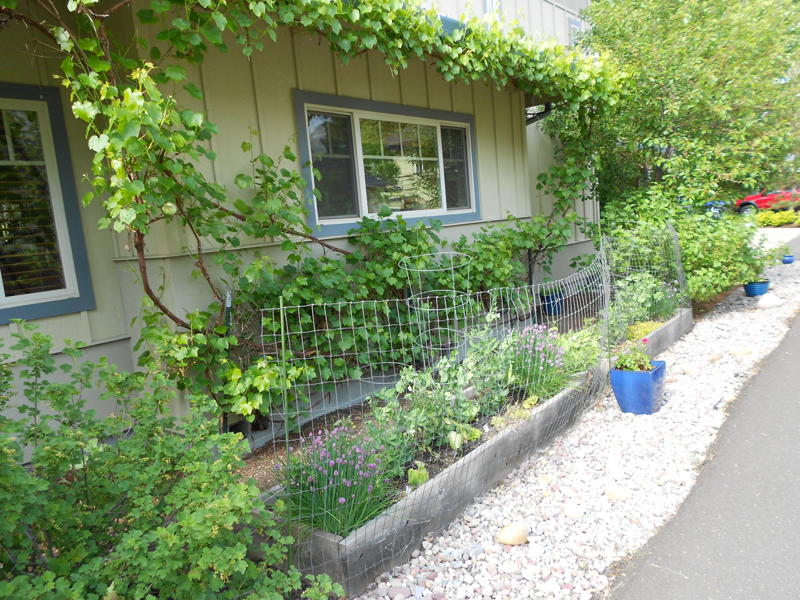
Vegetable plants are primarily on the left side of the fenced area in front, but placed
so carefully as to appear purely decorative. Among the many herbs throughout
but concentrated in back are sage, thyme, lavender, rosemary, sweet woodruff, and feverfew. Other plants include Korean forget-me-nots, euphorbia, lilac, butterfly bush, rose of sharon, lamium, tulips, hydrangea, gloxinia, wallflower, star magnolia, hellebore,foxglove, stewartia, peonies (including tree peonies), heuchera, daphne, cotoneaster, bleeding heart, columbine, viburnum, spirea, and forsythia. Laurels of several kinds as
well as photinia, Oregon grape, and a mugo pine add interest.

This is a lush and beautiful landscape.

RE-THINK: What’s Coming Up

An Information Source for
Reducing /Reusing/Recycling and Beyond
April 2011

WHAT’S COMING UP

10th Annual Rogue Valley Earth Day:
Now that spring has sprung there is more coming up than just daffodils and crocus. There are lots of events coming up in the Rogue Valley and this is just the start of the season. And what better way to kick it off than to attend the 10th annual Rogue Valley Earth Day, “Sowing Seeds of Stewardship.” This will get us outdoors to enjoy the weather, the magic of spring, learn more about conservation and have lots of FUN!

This event will be held at:
Science Works Museum
1500 Main St. Ashland
Saturday, April 23rd
11am- 4pm
Admission: Free

Visit over 70 exhibits to learn about solid waste reduction, local food and farms, energy conservation and much more. Enjoy live entertainment and activities throughout the day. There is also a free shuttle to the event. For more information go to www.RogueValleyEarthDay.net This event has lots of useful information, it gets us thinking about ways in which we can “re-think” our choices and practices, and it’s just plain fun.

Household Hazardous Waste Collection Day:
Do you have cleaning supplies, pesticides, insecticides, fertilizers, light ballasts, batteries, swimming pool chemicals or mercury thermometers that are no longer needed? Household Hazardous Waste Collection Day is an upcoming annual event where you can bring them for a safe, responsible disposal. For a complete list of acceptable and non-acceptable items go to www.roguedisposal.com

The event will take place at:
Rogue Disposal Transfer and Recycling
8001 Table Rock Road
White City OR
May 6th and May 7th
8am to 4pm
Admission: $5 fee per car

This event is hosted by Rogue Disposal and co-sponsored by Recology Ashland Sanitary and Southern Oregon Sanitation. It provides a valuable service to Rogue Valley residents.

One important note: with the advent of the Oregon Paint Care program, paint will no longer be accepted at this event. For more information regarding retailers who participate in this program and will accept unused paint year round go to: www.paintcare.org

Free Shred Day

This event will take place at:
South Valley Bank & Trust
116 W. Valley View Road
Talent, OR
Monday, April 18th
1:00 PM – 3:00PM
Cost: Free

Free Shred Day is sponsored by South Valley Bank & Rogue Shred to safely destroy personal documents. 3 boxes – 100 lb limit. For more information call: 541.535.6149

You’re doing a great job!
The amount of Ashland’s and Talent’s waste (in tons*) that has been diverted from landfills and has been recycled responsibly. Ready for the list?

Electronics: 94 tons/ Compact Fluorescent bulbs and tubes: 2 tons/ Ink Jet toners and cell phones: .4 tons/ Plastic Round-Up (another upcoming great event): 12.5 tons/ Commingle Recycling: 2,486 tons/ Glass:831 tons/ Cardboard:1,087 tons/ Soft film and plastic bags: 31 tons/ Mixed Metal:237 tons/ Lead Acid Batteries: 4 tons/ Used Motor Oil: 16 tons/ Tires: 14 tons/ Biomass:1008 tons/ Green Debris, Leaves and commercial compost: 2,307 tons/ Appliances: 71 tons

That’s a LOT of tonnage diverted from landfills !!
—– * Note: a ton is equal to 2,000 pounds!

In addition, last year, Jackson County exceeded its diversion percentage goal of 40% for the first time ever! Great Job!

Continue to REDUCE/ REUSE/ RECYCLE and RE-THINK!
Carla DiFabion, Master Recycler 2010

Happy Saint Patrick’s Day

May the Luck of the Irish be with You…..Lucky Shamrocks!

Irish folklore tells that in the 5th century Saint Patrick used the shamrock to explain the Trinity to the Druids. The word shamrock is derived from the Celtic word, “trefoil”, three-leafed, or “little clover”. Trifolium repens is the small white clover that is found in lawns and is used as a green manure cover crop. The Irish consider this to be the true shamrock, and is not the same shamrocks sold in nurseries for Saint Patrick’s Day.

Nowadays, the shamrocks sold for St. Patrick’s Day are members of the Oxalidaceae family. Oxalis are bulbous fibrous- rooted perennials which readily multiply, the genus has over 500 varieties and are native to South Africa and South America. Oxalis plants have photonastic movement which means they respond to light, so on a cloudy day and at night their leaves fold down. Their delicate clover-like leaves range in color from soft green, dark green, purple or a variegated mixture of these colors. Flowers come in a variety of colors: white, cream, yellow, pink, purple or red. The most common Oxalis Shamrocks sold for St. Patrick’s Day are:

Oxalis regnelli (Lucky Shamrock):
Exposure: Indirect sun, light shade
Hardiness: Zones 6-10, anywhere indoors
Height: 6″-8″
Foliage Color: Green
Flower Color: White

Oxalis triangularis (Purple Shamrock):
Exposure: Indirect sun, light shade
Hardiness: Zones 6-10, anywhere indoors
Height: 7″-10″
Foliage Color: Purple
Flower Color: White to light pink

Oxalis deppei (Iron Cross Shamrock):
Exposure: Indirect sun, light shade
Hardiness: Zones 8-10, anywhere indoors
Height: 10″-12″
Foliage Color: Soft Green with purple cross-shaped markings
Flower Color: Rosy pink flowers

Outdoor Care: Oxalis regnelli and Oxalis triangularis are hardy in zones 6-10. There are hardier varieties that can be grown outdoors as a ground cover. These plants are invasive and considered a weed in some areas. Many people grow them as houseplants to maintain control. Pots can be set outdoors in the summer then brought indoors in the fall before frost. Plant shamrocks in 2 parts peat moss to 1 part loam to 1 part sand and grow in bright indirect sunlight. While growing fertilize weekly with a balanced fertilizer. Shamrocks require a dormant period, so let them rest when they start dying back. Restrict all watering and fertilizing. Let the leaves die back naturally and remove them only after they have all turned brown. Let the plant stay dormant for 3 to 4 weeks, then start watering and fertilizing again.

Indoor care: Keep plant in a well-lit location (east or west window) away from hot and cold drafts at temperatures of 60-70F during the day and 55-65F at night. They should be kept barely moist at all times and not allowed to stand in water as that will cause root rot. Fertilize every 2 -4 weeks with a houseplant fertilizer. After bloom, if the plant dies back, allow it to go dormant for 1-3 months. The corms should be kept cool and dry. After dormancy, repot and or divide the corms (optional). When signs of new growth emerge, begin to water, fertilize and move to a sunny spot. For most indoor-grown shamrocks this dormant period occurs 2 to 3 times a year.

Re-Think: WORMS! WOW!

An Information Source for Reducing/Reusing/
Recycling and Beyond

March 2011

Have you ever thought of worms in your laundry room?Wigglers in your office? Or heaven forbid- critters in your kitchen?!Pretty scary thought-right?Maybe not-listen to what I have to say and you might change your mind.

Let me introduce you to vermiculture.Vermiculture is a term used to describe worm composting.Worms eat organic waste and produce some of the best compost around, known as worm castings or vermicompost.During this process worms do an excellent job digesting food wastes, breaking them down into simple plant nutrients. These nutrients are immediately available to plants; something that every gardener (and plant)will love.Worm composting has other great advantages.It can be done indoors or outdoors and even provides apartment or condo dwellers a way of composting when outdoor space is limited.Basically, all you need is a container filled with moistened bedding and of course, worms.Add food waste to the mix and the worms and micro-organisms will convert the entire contents into wonderful compost.Pretty simple- huh?!

Ready to get started?Select a container.It can be either wood or plastic and should be between 8”-12” deep.Simply drill 8-112 holes (1/4”-1/2”) in the bottom of the container for aeration and ventilation (worms need air to survive).The bin also needsa cover to provide darkness for the wigglers and to conserve moisture.If the worm container will be kept indoors a sheet of dark plastic or cloth draped over the top will suffice.If the bin is placed outdoors a solid lid is preferable to discourage unwanted critters and to keep out the rain.Place the worm bin on wooden blocks or bricks and place a tray underneath to catch excess liquid which can then be used as a compost tea for plants.Worm bins can be placed indoors all year round with temperature between 40-80 degrees- ideal to keep worms happy.Any location will work; make it convenient for you.If you will be placing your bin outdoors it can be placed in shed and garages or on patios etc.Don’t place it in direct sunlight and keep in mind that it might need to be moved if temperatures drop below 40 degrees.

Now that you have prepared your bin and have selected a spot to put it, the next step is to provide bedding.Bedding can be shredded newspaper, chopped up straw, shredded fall leaves etc.Toss in a couple handfuls of sand or soil.This will provide grit to aid the worm’s digestive process.The next step is to moisten the bedding.Add water until the bedding feels like a wrung-out sponge and then fluff it up to create air spaces.Fill the bin about ¾ full with the moistened bedding.

Now you are ready for the worms!Don’t be tempted to add earthworms or night crawlers; these are very beneficial in other areas but not as vermiculture candidates.One of the best types of worms for vermiculture are red wigglers.I’ll include a local source for these at the end of this article.

Worms eat many of the foods that we eat.Some ideas on preferable foods for worms are vegetable scraps, fruit peels, tea bags, coffee grounds etc.Avoid meats, oily foods, dairy products or grains.

I have only provided basic vermiculture information here but hopefully it has been enough to peak your interest in starting a worm bin of your own.

Rhianna Simes, OSU Extension Land Steward Coordinator for Jackson County Soil and Water Conservation District, is a source of additional information on vermicultureSchedule an appointment with her and she will share her knowledge on maintenance, harvesting, answer all questions and even give you a tour of her worm bins!She also has red wigglers available for purchase so you can get started!You might also consider reading Worms Eat My Garbage by Mary Appelhof.It is an informative book that offers useful and practical ideas about worm composting and vermiculture.

Now- red wigglers in a bin in the corner of your laundry room eating your kitchen scraps and producingthe best compost EVER, doesn’t sound like such a bad idea after all- does it?!Just think of them as “pets” that your plants will love!

Carla DiFabion,
Master Recycler

Additional information:
Rhianna Simes
Land Steward Program Coordinator
OSU Extension Jackson County Soil and Water Conservation District rhianna.simes@oregonstate.edu
541-776-7371

Worms Eat My Garbage
by: Mary Appelhof

Think in Gardens

Greetings Ashland Garden Club Members,
My friend, Anne Guy, the British garden designer, just let me know about a very interesting new website, which has been established in partnership with the Royal Horticultural Society.
It’s called: Think in Gardens and concerns itself with the following:
*The Contemporary aesthetics of gardens
*Gardens as they relate to the arts
*The value of gardens to non-gardeners
*The importance of gardens to society
*The relationship between gardeners & contemporary philosophy
The site is full of erudite essays, along with gorgeous photos.
Here’s the link: http://thinkingardens.co.uk

Nan Quick

Anne Guy’s website: http://www.anneguygardendesigns.co.uk/