Garden of the Month: May 2011

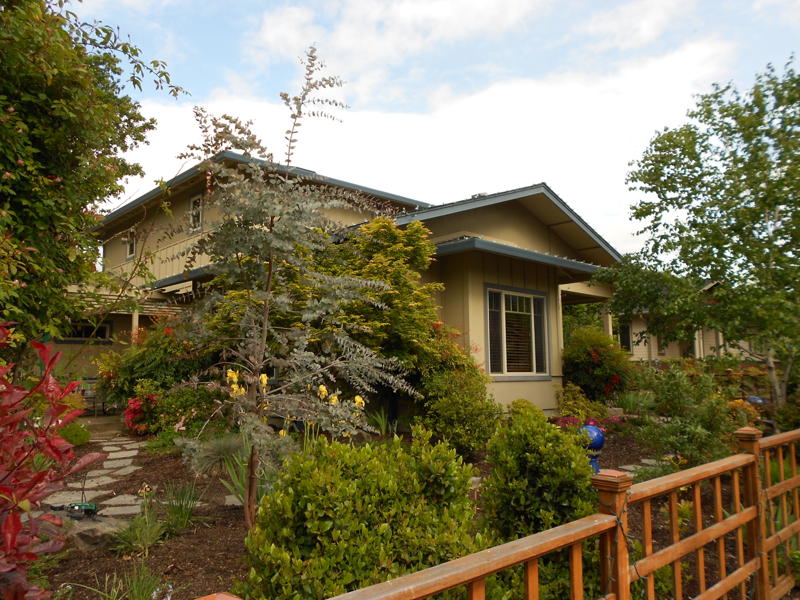
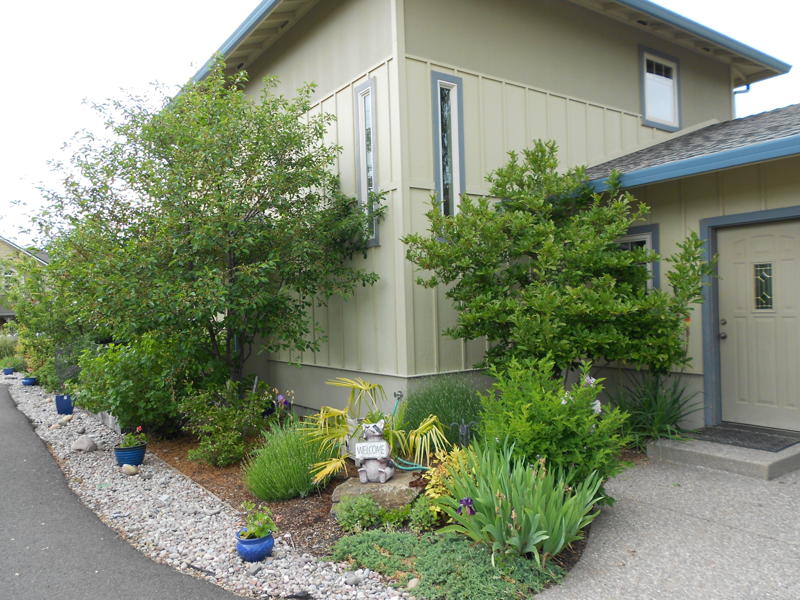
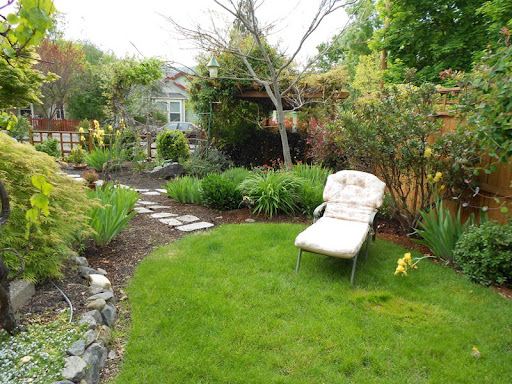
Winn Frankland’s beautiful garden at 122 High Street is a perfect spring garden, with
abundant flowers as well as buds and shoots appearing with the promise of more to
come. Frankland has gardened in this spot since coming to Ashland 16 years ago. She used to do all but the heaviest lifting herself, spending at least one hour a day. Now she has help in the garden four hours a week, while she practices Energy Medicine as developed by Donna Eden. Before coming to Ashland, she was a professional landscape designer in Chapel Hill, North Carolina, and transformed gardens in Tampa,
Florida.

Among the profusion of plants are many roses throughout the garden, including a hedge
of Simplicity roses and a climbing Peace rose which, at ten or eleven feet in height,
affords lovely views from a high deck and breakfast room. There are also David Austen roses and several Cecile Brunners.

Seeking equal-opportunity blessings for the garden, she has statuary of Buddha and
Saint Francis, and many smaller pieces, including a great frog who often wears a
charming hat of a blossom from the huge camellia nearby (the bush and its blossoms
are huge). There is a large tiered fountain in the back yard.

Frankland has custom-designed fences, screens, and gates—adapted from others she has seen—that allow views of the lovely garden, but keep the deer out. Because the crafty deer had discovered they could leap between the top of a gate and the bottom of an arbor that topped it, she designed a secondary section to the gate, creating an airy and clever Dutch-door effect.

The two largest trees are a huge spruce in back and an artfully-pruned deodar cedar
in the side yard. There are prolific fig, apple, pear, and cherry trees, including her first
foray into espaliering. She has a “grandfather” peach that doesn’t have a huge crop,
but that which it has are delicious, and remind her of her southern roots. There are many Japanese maples of varying ages, size, and varieties. The large tree to the left in the front yard is a maple with burgundy leaves. A dogwood along the driveway has been protected from deer with a wonderful wooden screen that matches other garden hardscape features. In addition, there are elderberry, madrone, and she recently added
a Hinoki cypress to the front yard for its architectural shape.

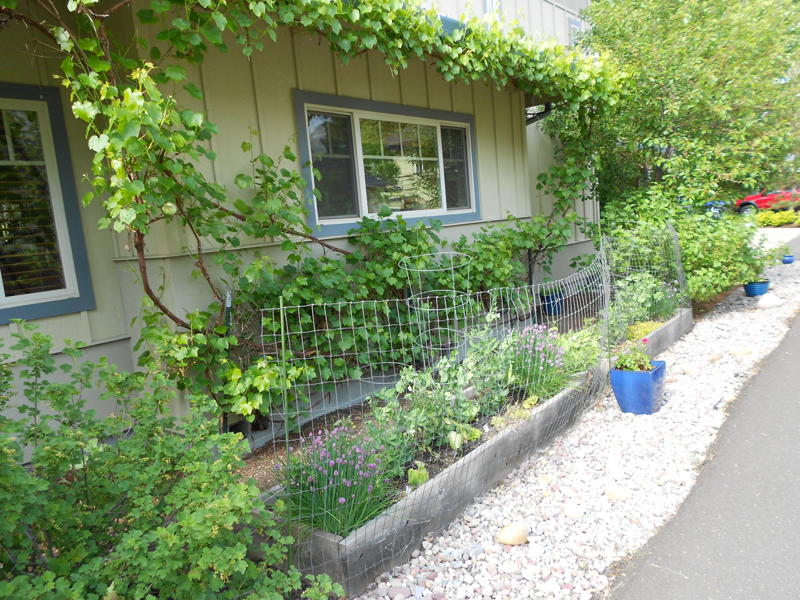
Vegetable plants are primarily on the left side of the fenced area in front, but placed
so carefully as to appear purely decorative. Among the many herbs throughout
but concentrated in back are sage, thyme, lavender, rosemary, sweet woodruff, and feverfew. Other plants include Korean forget-me-nots, euphorbia, lilac, butterfly bush, rose of sharon, lamium, tulips, hydrangea, gloxinia, wallflower, star magnolia, hellebore,foxglove, stewartia, peonies (including tree peonies), heuchera, daphne, cotoneaster, bleeding heart, columbine, viburnum, spirea, and forsythia. Laurels of several kinds as
well as photinia, Oregon grape, and a mugo pine add interest.

This is a lush and beautiful landscape.

Garden of the Month: September 2010

Linda Truax and Rick Jacobs have owned the property at the northwest corner of Park Street and Hope Street for 26 years. They have gardened the nearly half-acre here seriously for nearly twenty years and have developed a beautiful and serene, mostly shady garden working slowly and deliberately almost entirely on weekends only. Linda, especially–consulting occasionally with Jane Hardgrove–has developed an uncommonly fine eye for color, texture, and shape. She has created an enchanting space.

A colorful, constantly changing, border draws the eye in from Park Street. Bright yellow Coreopsis are noteworthy in August. Massive trees, including a beautifully spreading and healthy walnut that is over 100 years old, as well as Deodar Cedar, pine, birch, and Liquidambar dot the emerald green lawn (Rick’s specialty). A charming, whimsical metal sculpture by Cheryl Garcia is featured in a shady spot, and colors are everywhere.

Sections of the garden have names to distinguish them. There is the herb garden close to the house with its sculptural rock retaining wall; the “railroad-tie” garden features a pleasant place to sit among the many blooming and thriving plants that include Rhododendron, ferns, and candy tuft; a “woodland” garden that was revealed when the lowest branches of the Cedar deodara were trimmed away where plants that thrive in shade were added and volunteered; the “bird bath” bed includes Japanese anemone, Daphne odora, Acer suminagastui, and Forsythia; and other sections that have character all their own. The enormous walnut tree provides shade for a terrace paved with flagstone and lined with Helleborus, Geraniums, Hydrangeas, and Impatiens. Secret spaces are shared with neighbors to the north.

At other times of year, two types of Viburnum (davidii and shasta) draw attention in the front yard. Also featured there are Daphne odora, Winter and Summer heather, and Japanese anemone. A Japanese Maple adds a touch of contrasting color most of the year and a perfect shape and mass year-round. Grouped potted plants ornament the deck and entry. Fragrance near the front door comes from Jasmine both planted in a pot and growing against the chimney.

The owners have made minor changes (by eliminating certain plants) over the years to acknowledge the increasing presence of deer. But the many squirrels who covet the walnuts are welcome, and Linda reports that they don’t do much damage. Lilac hedges line the driveway that has been paved interestingly with exposed aggregate and plain concrete, including a bump-out for parking an additional car. A lilac hedge also lines part of the Hope Street side of the property although it was recently cut back drastically at the city’s demand.

Anyone lucky enough to have Linda guide them through the gardens (she’s a gracious hostess) will be rewarded with gorgeous sights in every direction.

Garden of the Month: August 2010

71 Water Street-

This expansive garden is a hidden treasure in Ashland. The street address is 71 Water St.; however, unlike most of our Garden of the Month choices, you’ll have to park and walk a bit to view these gardens. It will be worth the effort. Either park on Water St., or around the corner on Central. An Ashland Garden Club “Garden of the Month” sign will lead you towards the short path for a view of the garden, which is in fine array in August. You will note that there is a sign saying “No public passage;” however, the gardens can easily be viewed from the main path, which is a public walkway, and also from the lawn, if you walk up and towards the far end and look back for the long view from the West.

There is no single “owner” of the garden, which is managed cooperatively by the homeowners association of the Water Street Condominiums. The main long garden was designed by John Stadelman of Green Man Gardens. John is a graduate of the KLC College of Design in London, U.K., and has an impressive portfolio to show for it.

Before the current garden was installed, the view from the Water Street Condominiums, and from the other condominiums on the slope above would have been mainly lawn with a few cherry trees. The lawn grass was suffering from construction compaction, and from a drainage issue, being down slope. Much attention to drainage and soil amendment had to be done before planting could begin. John was asked to design a garden that would border both sides of the viewing path which fronts the condominiums. Another request was to create some privacy for condominium owners on the ground floor, without impeding their patio views.

An early concept was for there to be a “river of grass” through and across the gardens. This is accomplished with the use of a variety of grasses. The shorter grasses in the center are Pennesetum alpecuroides ‘Little Bunny’. In August, the golden billows of Nassella tenuissima, or Mexican Feather Grass move in the wind, as do the spires of Stipa gigantea. In the background you will see tall clumbs of Miscanthus sinensis ‘Gracillimus’. Deschampsia aespitosa ‘Goldtau’, or Tufted Hair Grass, provides a lacy, fine-textured contrast. Variations in color are provided by Festuca glauca ‘Elijah Blue’, and by the bronze sedges, Carex comens and C. bucchananii . Calamagrostis x acutiflora ‘Karl Foerster’ , the Feather Reed Grass, is used on a berm as a privacy screen.

Artfully surrounding and mixed with the grasses are a variety of shrubs and perennials. You will find both heathers and heaths, barberries, carpet roses, dwarf Mugho Pines, and Blue Spruces. At the upper levels of the slope are Rockroses, Smokebush, and, around back on the lawn side, Rugosa roses. Color is now being provided by Black-eyed Susans, Rudbeckia hirta, lavenders, Russian Sage, Perovskia, and Ox-Eye Sunflower.

Like many of our gardens, this garden has suffered some damage from the local deer, and some plants, such as the Indian Hawthorn, are being heavily eaten, and may eventually be replaced. Fortunately, deer leave grasses alone, and the other choices of shrubs and perennials have been wise.

I hope you will take a few minutes to view this lovely garden. It is an example of the wonderful variety of grasses that grow well in our climate, and the many plants which can be used with them to good effect