Follow this link to read Nan Quick’s Travel Diary.
She attended The Royal Horticultural Society’s Chelsea Flower Show!
Follow this link to read Nan Quick’s Travel Diary.
She attended The Royal Horticultural Society’s Chelsea Flower Show!
Due to our lush landscaped yards, Ashland is the deer’s “breadbasket”. Deer are browsers. They consume their total food intake in many different locations throughout the night and they eat an estimated 6 to 8 lbs. of green leaves, stems, flowers, fruits and buds of woody plants a day.
One way to diminish the severity of deer damage is to select plants considered to be “deer resistant”. The pictures below are a few deer resistant plants growing in my unfenced front yard. We have 2-4 deer resting in our front yard nightly and to date these plants have never been damaged. Please remember “resistant” does not mean deer won’t ever eat these plants! Deer seem to change their food preferences every year, and fawns in particular like to taste test everything just to check out if it’s palatable. Good Luck!
Salvia Microphylla – Hot Lips
Height: 2 to 3 feet
Spread: 1 to 2 feet
Bloom Time: August – October
Bloom Color: Bi-color white & Red
Sun: Full sun to part shade
Water: Medium to low
USDA Zone: 7 to 9
Perennial
Salvia Elegans- Pineapple Sage
Height: 3 to 4 feet
Spread: 2 to 3 feet
Bloom Time: August – October
Bloom Color: Red
Sun: Full sun
Water: Medium to low
USDA Zone: 8 to 11
Considered an annual in our area but can winter over.
Hummingbirds love this flower!
Penstemon Barbatus– Bearded Tongue or Beardlip Penstemon
Height: 2 to 3 feet
Spread: 1 to 1.5 feet
Bloom Time: June until frost
Bloom Color: varies (Red, Purple, White, Pink)
Sun: Full sun
Water: medium
USDA Zone: 4 to 8
Perennial
Crocosmia “Lucifer”
Height: 2 to 4 feet
Spread: 1 to 2 feet
Bloom Time: June – August
Bloom Color: Scarlet red
Sun: Full sun to part shade
Water: Medium
USDA Zone: 5 to 9
Perennial
List of Other Deer Resistant Perennials ( Seldom Damaged)
550 Fordyce Street-
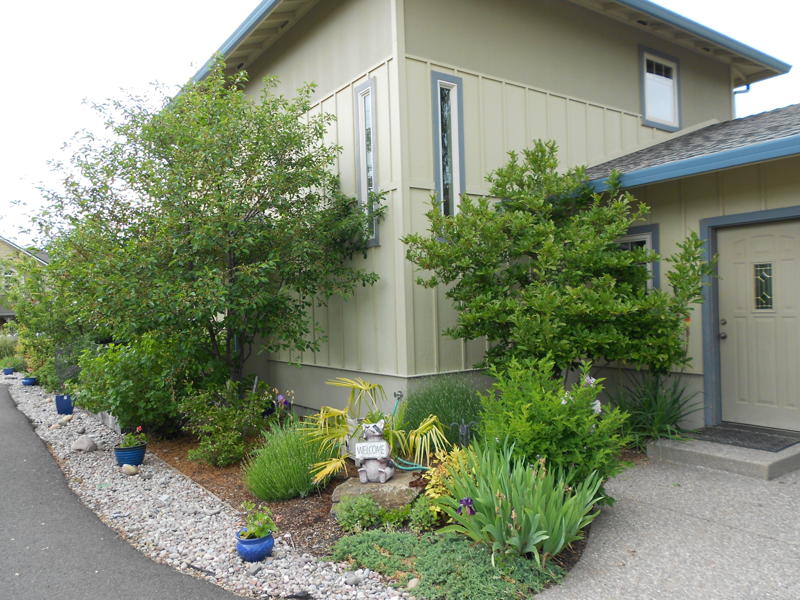
Up until eight years ago, June’s Garden of the Month at 550 Fordyce Street was pastureland hosting llamas and pigs.Alla and John Farrell and their three sons moved into the new house in 2004.The garden was professionally installed, but since then, Alla (with some help from her sons, now 19, 15, and 11) has developed the garden into a showplace.
An attractive redwood fence (alas, not high enough to keep out deer) separates the front garden from a carefully planted verge along the street, giving pleasure to all who pass by.(The verge includes deer-resistant Oregon grape, pampas grass, flowering plum trees, rock rose, burning bush, rhododendron, and various evergreen shrubs.)
Approaching the front door, a birch tree, drought-tolerant evergreen ground covers, and a bed of annuals greet the visitor.Alla tries different annuals every year.This year, it’s geraniums with a verbena border.Bright blue ceramic balls from Legends Pottery Outlet in Central Point add a whimsical touch.Tea lights in glass holders and year-round Christmas lights add a festive touch at night.
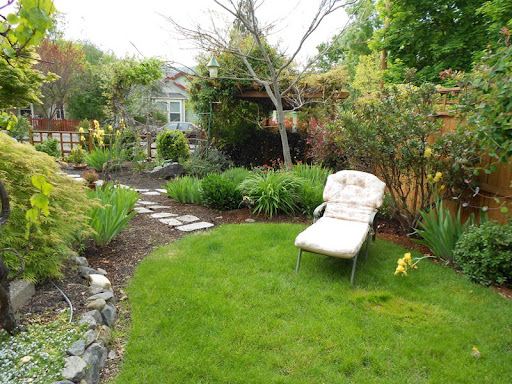
Three separate patio gardens give welcome shade and entertainment spaces in the summer.A small one in the corner of the front yard is covered by an arbor with climbing rose coming from one side and wisteria from the other.Walking through an archway of clematis, a side patio attached to the house is framed by a wandering Chardonnay grape.(Unfortunately, raccoons love this grape.)Large pots are planted with mixtures of shade-lovers, especially begonia, for a splash of color.In 2007, Alla built a terraced back patio garden, planting a fruitless mulberry for shade, as well as dogwood, oak leaf hydrangea, and smoke bush. A variety of honeysuckles and trumpet vine adorn side and rear fences, attracting hummingbirds and giving privacy.
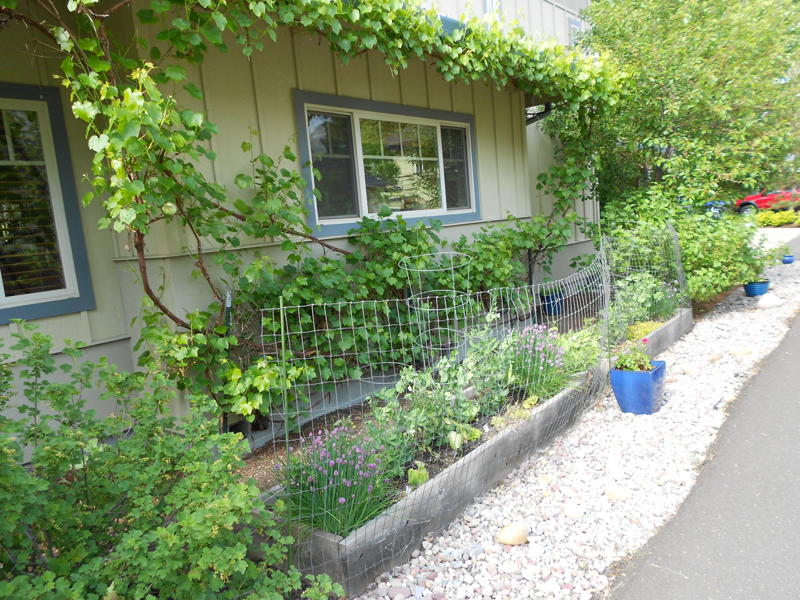
The south side of the property – a narrow strip outside the kitchen window along a driveway to a rear flag lot – is devoted to a delightful kitchen garden, with blueberry, black currant, red currant, and gooseberry bushes (Alla uses them for jam and jelly, as she did in her native Russia); cherry and pear trees; a white, seedless grape framing the kitchen window; and two small raised beds with a variety of vegetables and herbs. Bright blue ceramic pots along this side of the house on a stream of small river rock continue the whimsical theme from the front yard, softening the driveway further.
The front south side is bordered with a thornless climbing rose along a low fence. Japanese maples, burning bush, and fall mums dot the property for a blaze of autumn color.Alla has mixed various shades of evergreen shrubs for added interest.
Other attractive plantings in the Farrells’ garden include a silver dollar eucalyptus by the front patio; iris, azalea and rock rose; mimosa, veronica, camellia, Blaney’s blue rhododendron, baby lilac, and star magnolia; chocolate mimosa and chocolate maple (Alla loves chocolate); black lace elderberry, a columnar blue spruce, and even a fan palm. A small garden with a longleaf pine tree and a border of boxwood and annuals softens driveway concrete.Weeds are kept at bay with a thick layer of bark mulch (and the help of sons).
The Farrells’ garden will be open for viewing on Saturday, June 11, from 11 a.m. to 1 p.m.
— Julia Sommer

Xeriscaping sounds like a funny term that is difficult to pronounce and has been a horticulture buzz word for a period of time now. But, it is really a combination of the Greek word “xeros” meaning dry and landscape. It was coined back in the 1970s in Colorado when the Denver area was experiencing a period of arid
weather and rapid urban growth. Landscape practices were developed to utilize less water.
Throughout the years since then xericaping has transitioned from high country drought tolerant gardening to encompass water conservation principals. These techniques can apply to many styles of horticulture designs.
Today, xeriscape gardening refers to water conservation through creative landscaping techniques and practices. Here are some principles to consider:
Plant placement is important, too:
The key idea to remember in xeriscape gardening is water conservation. Our earth has a finite amount of water and the demands are becoming increasingly greater. A common-sense approach to gardening keeping these principals in mind can be applied to most garden designs. The Rogue Valley has ideal climate In fact,
I am sure that many of you are already practicing xeriscape gardening and just hadn’t referred to it as that!
I’m including a short list of waterwise plants that will do well in the Rogue Valley but bear in mind that this is just an introduction. I have listed the botanical name first followed by common name. An added bonus to drought tolerant plants is that most are deer resistant! What more can we ask for?!
Grasses
Perennials
Shrubs
Trees
As we go into the growing season consider our landscape water use and ReThink our choices. We can have beautiful landscapes and gorgeous gardens with careful planning and still protect and preserve our precious resource: water.
Carla DiFabion
Master Recycler 2010
Skeletonized leaves, round black debris and damaged tomatoes – sure signs of tomato hornworm damage. The hornworm is a larval form of a stout bodied, strong flying hawk or sphinx moth. The moth has a long probiscus to feed on deep-throated flowers and, in the process, is an important night time pollinator.
Damage done to tomato plants is by the caterpillar or larva. The caterpillar is green with distinctive eye spots on the side. In Jackson County they hatch in the spring after overwintering in the soil. The small green caterpillars grow and change rapidly, consuming tomato plants in addition to other members of the Solanaceae family. For the average home gardener, uncontrolled tomato plant damage may lead to an incomplete crop as the damaged plant tries to survive defoliation.
The best way to control the caterpillar is by practicing a combination of monitoring and removal. Check tomato plants every few days for signs of damage. During the warmer months the pest grows very quickly into a master of deception, hiding underneath stems and leaves. If the pest is found, hand pick and immediately destroy. While doing garden observations I always take a container of soapy water for disposal of unwanted insects. Some may prefer to crush or destroy in another way but either way, the earlier you find the caterpillar, the less damage it can do.
WHAT’S COMING UP
10th Annual Rogue Valley Earth Day:
Now that spring has sprung there is more coming up than just daffodils and crocus. There are lots of events coming up in the Rogue Valley and this is just the start of the season. And what better way to kick it off than to attend the 10th annual Rogue Valley Earth Day, “Sowing Seeds of Stewardship.” This will get us outdoors to enjoy the weather, the magic of spring, learn more about conservation and have lots of FUN!
This event will be held at:
Science Works Museum
1500 Main St. Ashland
Saturday, April 23rd
11am- 4pm
Admission: Free
Visit over 70 exhibits to learn about solid waste reduction, local food and farms, energy conservation and much more. Enjoy live entertainment and activities throughout the day. There is also a free shuttle to the event. For more information go to www.RogueValleyEarthDay.net This event has lots of useful information, it gets us thinking about ways in which we can “re-think” our choices and practices, and it’s just plain fun.
Household Hazardous Waste Collection Day:
Do you have cleaning supplies, pesticides, insecticides, fertilizers, light ballasts, batteries, swimming pool chemicals or mercury thermometers that are no longer needed? Household Hazardous Waste Collection Day is an upcoming annual event where you can bring them for a safe, responsible disposal. For a complete list of acceptable and non-acceptable items go to www.roguedisposal.com
The event will take place at:
Rogue Disposal Transfer and Recycling
8001 Table Rock Road
White City OR
May 6th and May 7th
8am to 4pm
Admission: $5 fee per car
This event is hosted by Rogue Disposal and co-sponsored by Recology Ashland Sanitary and Southern Oregon Sanitation. It provides a valuable service to Rogue Valley residents.
One important note: with the advent of the Oregon Paint Care program, paint will no longer be accepted at this event. For more information regarding retailers who participate in this program and will accept unused paint year round go to: www.paintcare.org
This event
will take place at:
South Valley Bank & Trust
116 W. Valley View Road
Talent, OR
Monday, April 18th
1:00 PM – 3:00PM
Cost: Free
Free Shred Day is sponsored by South Valley Bank & Rogue Shred to safely destroy personal documents. 3 boxes – 100 lb limit. For more information call: 541.535.6149
You’re doing a great job!
The amount of Ashland’s and Talent’s waste (in tons*) that has been diverted from landfills and has been recycled responsibly. Ready for the list?
Electronics: 94 tons/ Compact Fluorescent bulbs and tubes: 2 tons/ Ink Jet toners and cell phones: .4 tons/ Plastic Round-Up (another upcoming great event): 12.5 tons/ Commingle Recycling: 2,486 tons/ Glass:831 tons/ Cardboard:1,087 tons/ Soft film and plastic bags: 31 tons/ Mixed Metal:237 tons/ Lead Acid Batteries: 4 tons/ Used Motor Oil: 16 tons/ Tires: 14 tons/ Biomass:1008 tons/ Green Debris, Leaves and commercial compost: 2,307 tons/ Appliances: 71 tons
That’s a LOT of tonnage diverted from landfills !!
—– * Note: a ton is equal to 2,000 pounds!
In addition, last year, Jackson County exceeded its diversion percentage goal of 40% for the first time ever! Great Job!
Continue to REDUCE/ REUSE/ RECYCLE and RE-THINK!
Carla DiFabion, Master Recycler 2010