Firewise: August 2012

This weekend brings us the first  opportunity of the season for extreme fire danger coupled with the potential for lightning. It is the time of year that wildfires can strike at a moment’s notice, and embers can ignite fires wherever they land. Remember these fire season and Firewise resources until we get that first wetting rain of fall. Remember that firebrands can land up to a MILE ahead of a wildfire. You do not have to live in the forest to be impacted by a wildfire…you just have to live downwind of a fire, and in Ashland, any neighborhood can be impacted by embers.
 
First: Look at your home and the first ten feet around the foundation. Move anything that could burn away from your home. This includes bark mulch, dead leaves (yes, the space under your deck counts!), stacks of lumber, and especially firewood. If it can burn, do not let it touch your house! Use only well watered and maintained fire-resistant plants in this area.
Second: Look Up! Make sure your gutters and roof are clean. This can help protect your home from igniting from embers.
Third: Stay Informed. The Ashland wildfire hotline (541-552-2490), Citizen Alert, and 1700 AM Ashland Emergency Radio are  great resources to know about during a wildfire event. You have to register your cell phone with Citizen Alert if that is how you want to be notified of an emergency. Land lines are already included, but really, are you planning on being at home during a wildfire? You never know, so take the 5 minutes to register your cell phone number! For wildfires outside the Ashland city limits, check out the Oregon Department of Forestry blog swofire.blogspot.com. It is full of updates on local fires.
Fourth: Know Firewise. You may not be planting now, but before you do, check out the host of resources regarding fire-resistant plants and construction materials  available on ashlandfirewise.org. The new OSU Extension Fire-Resistant Privacy Screening publication is available there, as well as other plant lists, Firewise Tips, grant information, and additional resources. Our Facebookpage has some great photos and other tips found nowhere else! Like it to see what’s new!
Fifth: Be careful with fire. Know fire season restrictions that apply to you.
 
The smoky skies outside are a daily reminder that we live in wildfire country. We all share the responsibility for being prepared for a wildfire. Have you done everything you can to be Firewise?
As always, Ashland Fire & Rescue is here to help you with grants, information, and a free wildfire safety home evaluation service to residents of Ashland.
Wishing you a safe summer,
 
Ali True/Firewise Communities Coordinator
City of Ashland / Ashland Fire & Rescue
455 Siskiyou Boulevard  Ashland, OR 97520
541-552-2231

Garden of the Month: August 2012

Hidden Springs Wellness Center:
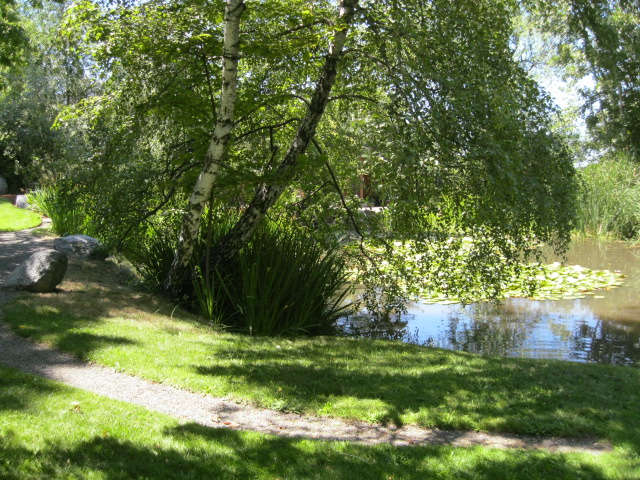
In the dog days of August, the cool, green garden at Hidden Springs Wellness Center can be a blessed relief from the acres of asphalt at Ashland Shopping Center.
Accessed through a sweet gate at the top corner of the shopping center parking lot, the one-acre Hidden Springs garden offers a large pond with blooming water lilies and visits by waterfowl, including a blue heron, plus at least one giant koi (the heron tends to eat the koi).  The pond is fed by springs and a pump powers a recirculating stream meandering up to the Wellness Center designed by Jim Bowne.  Ian Wessler of Wessler Design Associates did some of the initial landscape and pond design.  Cottonwood trees complete the pond’s rural feel.
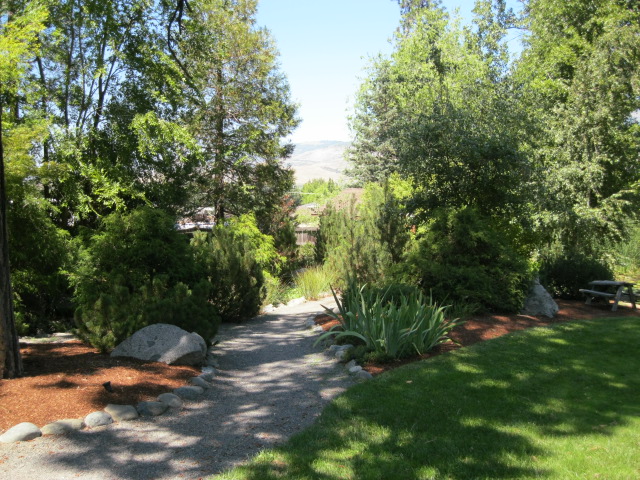
Rod and Brooks Newton bought what is now the thriving Hidden Springs Wellness Center in 1999.  It had been a private home, but thanks to the adjacent shopping center, part of the lot was zoned commercial.  Now the center is home to 14 wellness practitioners, including therapists, coaches, massage therapists, naturopathic doctors, and a fitness center.  It also hosts classes and workshops.  You would never know that the Tidings building and the shopping center are right outside, so well have the plantings grown, including Japanese maples, Mugo pines, a Kwanzan cherry tree, and beeches.
When the Newtons took possession, the pond was there, full of cat-tails and blackberries.  With the help of friends, they pulled out the blackberries by hand; no chemicals have ever been used in the garden.  Then they hauled in huge rocks from their Ashland home to dot the property.  Original fruit trees and ponderosa pine continue to thrive.  The garden is made even more inviting by small picnic tables, a swinging tree chair, and a bench by the pond.  The garden is open to the public; the gate is never locked.  The Newtons simply ask visitors not to interfere with Wellness Center activities.  Workers from the shopping center who’ve discovered the gate enjoy their lunch breaks there.
For the past ten years, Paul Garber has taken care of the garden.  Many people have also contributed in trade for classes, workshops, and wellness services, including construction of a little Japanese bridge over the stream as you first enter the garden.  Elizabeth York of Ashland has donated much of the plant material.
As the Wellness Center has been enlarged and remodeled, the gardens surrounding it continue to be upgraded.  A raised bed for herbs is currently under construction by the new fitness center.
Julia Sommer

Garden of the Month: July 2012


From the Street
354 Wrights Creek Drive :
A shady oak glen in front of the home of Linda and Tony Fern at 354 Wrights Creek Drive has been transformed into a colorful and imaginative, peaceful garden.  The Ferns have graciously opened their garden to Ashland Garden Club members during the entire month of July!  They ask only that you enter and exit via the wooden gate at the front, taking care to latch the gate as you arrive and depart.  The handsome iron ring twists to operate the latch. With any luck, you will catch Tony gardening. He’s out there a lot and his hard work is much in evidence.
Along the Driveway

Tony does most of the work, selecting, positioning, planting, and pruning the plants.  Initially, Bonnie Baird designed the hardscape and perimeter plantings about ten years ago, but Tony has made all the subsequent choices.  A crew comes in regularly to help with cleanup, dead-heading and raking.  Tony designed and built the front gate as well as the pergola on the left side of the house.  He designed the complex of decks, stairs and bridges at the front of the house.  The deer fence has been in for only about a year, so the garden is now only in its first year of unfettered growth but it already looks well established.

The gorgeous garden replaced a lawn that previous owners had planted.  The process of substituting the lawn took two years, accomplished about a quarter at a time to reduce shock to the oak grove that shades the property.  When the garden was being established, the Ferns had 80 yards of compost brought in.  Since then, 60-70 yards of bark have been distributed twice to help retain moisture and reduce weeds.
 The Ferns added a recirculating pump to the little waterway that follows a naturalculvert, piped under neighborhood driveways, that ultimately joins Wrights Creek.  The stream bed has been lined and artfully bordered with rocks.  Art pieces abound and colorful plant supports add to the cheerful ambiance.  Colorful flags mark spots where Tony plans to add bulbs in the Fall, knowing those plantings will not interfere with an abundance of bulbs already in place but not currently visible (wish I’d thought of that!).
Asiatic Lilies
Right now, Asiatic lilies are putting on a spectacular show throughout the garden.  Tulips and daffodils have come and gone for the year.  Perimeter plantings concentrate on natives and drought-tolerant plants, including cotoneaster, ceanothus, Oregon grape, rockrose, Russian sage, smoke tree, and manzanita.  Other parts of the garden include lilacs, daphne, Japanese maple, pieris, and Mexican orange.  Laurels include English, Portuguese, and mountain.  Redbud trees and strawberry bushes, one recently replaced, flank the inside of the front gate. Double-potted bamboo screens the hot tub.
Japanese Umbrella Tree
 Among some highly unusual
and beautiful plants are a Japanese umbrella tree and broad-leaf ceonothus.   
There are, of course, ferns—both animal and vegetable.
— Ruth Sloan

Finding Nutrient Values of Organic Fertilizers

How to find the nutrient values of organic fertilizers
By Judy Scott 
Oregon State University Extension Service
CORVALLIS – Gardening resources often recommend chemical fertilizers with N-P-K (nitrogen, phosphorus, potassium) ratios, but for organic gardeners, the numbers can be frustrating. Manure and other organic materials often don’t come with N-P-K ratings, especially if purchased in bulk.Organic gardeners are in luck. Ross Penhallegon, horticulturalist with the Oregon State University Extension Service, collected information about the nitrogen, phosphorus and potassium content of many organic substances commonly used as fertilizer in Oregon, including green manure crops such as crimson clover and alfalfa.His report, “Values of Organic Fertilizers,” is online at http://bit.ly/KHXBQl.It has information on the top sources of organic fertilizers, their NPK content, release speed and effectiveness.

“Nutrient values vary greatly among organic fertilizers,” Penhallegon said. “They also vary greatly for a given organic fertilizer.” Differences include variations in the age of organic material, decomposition, application method, timing, incorporation time, and time exposed to the elements (rain, sun).

“One of the most difficult things to determine for an organic gardener is how much organic fertilizer to use, say on 1,000 square feet of garden,” Penhallegon said. “For a fertilizer with an N-P-K ratio of 12-11-2, this means 12 percent is nitrogen, 11 percent is phosphorus and 2 percent is potassium. In simple terms, this means each 100 pound bag of the fertilizer would contain 12 pounds of nitrogen, 11 pounds phosphorus and two pounds nitrogen.”

Cover crops generally release their nutrients slowly, over two to six months, Penhallegon said. Nutrient values for cover crops include: alfalfa, crimson clover, Australian winter peas and annual rye.

Blood meal, bat guano and many of the manures (variable nutrient contents) release their nutrients over two to six weeks. Burned eggshells, fish emulsion and urea (urine) are the fastest-acting organic fertilizers, lasting only a couple of weeks.

To boost the nitrogen content of your soils, apply nitrogen rich urea, feathers, blood meal, bat guano or dried blood. Manures are usually less expensive than other animal by-products. Organic amendments highest in phosphorus include rock phosphate, bone meal and colloidal phosphate. High in potassium are kelp, wood ash, granite meal and greensand.

To make soil less acidic, use materials rich in calcium, including clam shells, ground shell marl, oyster shells, wood ashes, dolomite and gypsum (all are at least 30 percent calcium carbonate or straight calcium).

Source: Ross Penhallegon, Hhorticulturalist 
Oregon State University Extension Service

2012 State Photo Contest Winner!

Carlotta Lucas’ photograph, below, won in the architectural category at the district level and went on to win that category at the state convention.  We can all be proud of her for having her lovely photo be a state winner!

Marilyn Love
AGC President

Title: Tea Time
Location: Gazebo at Harlow-Carr Botanical Garden – Yorkshire, England
Date Taken: May 2012
Taken by: Carlotta Lucas
Photo Copyright Protected

Southern Oregon Wildflowers

Here are a few pictures of the many wildflowers currently (June 24, 2012)  blooming roadside by Fish Lake( Hwy 37), Howard Prairie Lake, Hyatt Lake and Little Hyatt Lake.

Gilia capitata (Blue Field Gilia)
Camassia quamash (Common Camas)
Castilleja hispida ( Short-lobed Indian Paintbrush)
Dicentra formosa (Bleeding Hearts)
Penstemon laetus ( Mountian Blue Penstemon)
Zigadenus venenosus (Meadow Death Camas)
Tragopogon dubius (Goatsbeard)
Calochortus tolmiei    (Tolmie’s Pussy Ears)
Allium siskiyouense (Siskiyou Onion)
 Corallorrhiza mertensiana(Western Coral-Root Orchid)
Balsamorhiza deltoidea (Northwest Balsamroot)

Photo by: Carlotta Lucas
(all rights reserved)