USDA: Web Soil Survey

“The Web Soil Survey (WSS) provides soil data and information produced by the National Cooperative Soil Survey. It is operated by the USDA Natural Resources Conservation Service (NRCS) and provides access to the largest natural resource information system in the world.”  USDA  Natural Resources Conversation Service

To find your soils on the web soil survey go to http://websoilsurvey.sc.egov.usda.gov/App/HomePage.htm


Winter Gardening: Cold-Hardy Vegetables

CORVALLIS, Ore. –  Not ready to hang up your gloves and spade just yet?

The fearless gardener still has a chance to plant some cold-hardy vegetables to harvest next spring, said Jim Myers, plant breeder and researcher at Oregon State University. But don’t dawdle.

“Winter gardening is a risky business,” Myers said. “It may work one year with a mild winter but not another when the weather is more severe. If you plant some cold-hardy vegetables from mid-August to early October – depending on the crop – there’s a good likelihood you will produce something on the other end in the spring. They say farming is a gamble…some years more than others.”

Cold weather doesn’t kill these hardy plants; it simply slows their growth rate. For every rise of 18 degrees, growth rate doubles, but that guideline is only applicable for an air temperature range of 40 to 98 degrees, Myers said. If you plant cold-hardy vegetables from mid-August to early October, there is a chance they can mature by next spring if they survive in a vegetative state through the winter without reproducing.

According to Myers, the hardiest vegetables that can withstand heavy frost of air temperatures below 28 include: spinach, Walla Walla sweet onion, garlic, leeks, rhubarb, rutabaga, broccoli, kohlrabi, kale, cabbage, chicory, Brussels sprouts, corn salad, arugula, fava beans, radish, mustard, Austrian winter pea and turnip.

Semi-hardy vegetables that can withstand light frost of air temperatures in the range of 28 to 32 degrees include: beets, spring market carrots, parsnip, lettuce, chard, pea, Chinese cabbage, endive, radicchio, cauliflower, parsley and celery. For beets, spring market carrots and parsnips, the tops will die but the roots will tolerate lower temperatures.

Vegetables that contain the pigment anthocyanin, which gives them a vibrant red or purple color, are more resistant to rots caused by winter rains, Myers said. They include: purple-sprouting broccoli, Rosalind broccoli and purple kale.

If you live in an area of the state that gets prolonged snow cover, the fluffy white stuff acts as insulating mulch and warms the soil for these tough plants, Myers said.

No matter where you live in Oregon, “some of the worst problems we have in the winter are with rain rather than temperature, so protecting plants from the rain is quite helpful,” Myers said.

He recommends covering vegetables with high or low tunnels made from metal hoops and clear plastic, available from greenhouse supply companies. To protect plants, you can also use row covers or cloches. To warm the soil use mulch made from yard debris, cardboard or newspaper.

Cross your fingers and by next March you could be feasting on shelled, succulent fava beans seasoned with salt and lemon juice.

For more information on extending the gardening season, see the OSU Extension guides “Fall and Winter Vegetable Gardening in the Pacific Northwest” at http://bit.ly/OSU_FallGarden, “How to build your own raised bed cloche” at http://bit.ly/OSU_Cloche and “Garlic for the Home Garden” at http://bit.ly/OSU_Garlic. For an interactive map of Oregon’s first frost dates, go to the United States Department of Agriculture’s website at http://bit.ly/USDA_FirstFrostOR.

By Denise Ruttan denise.ruttan@oregonstate.edu

Source: Jim Myers  myersja@hort.oregonstate.edu

This story is online at http://bit.ly/OSU_Gardening2293

Garden of the Month: September 2013

The home at 340 Morton is currently owned by Betsy Wessler and the garden is at its peak in late summer.  Kaaren Anderson talked with Betsy last spring to gather a little history on the home and the lovely garden that surrounds it.
IMG_0092
The home was originally built in 1948 and was formerly owned by Dick and Evelyn Strellman.  Betsy purchased the home in 2007 with a move-in date of 2008.  Soon after, the house, as well as the entire yard, were renovated and redesigned.  Betsy’s former husband, Ian Wessler of Wessler Design Associates, worked with her to create the beautiful garden you see today.
 

IMG_0091The first major change was to move the driveway to the far right of the front yard from its former location closer to the house and entry way.  This gave a much broader area to reconstruct the garden.  The entrance to the garage, which originally faced the street, was reoriented to create a turnaround at the end of the new driveway.  Broken concrete pieces from the driveway were used to form walkways leading to the entry and around the house to the garage.IMG_0089

One challenge with the design involved mitigating a seepage problem located at the right rear of the front yard.  This was done by lowering the grade to create a gravel and rock lined dry creekbed, directing water through the front yard to a gated front vegetable garden.  As you will see, it is this creekbed that is beautifully lined with boulders and various tall grasses.  Winding back through these grasses one can find a Triflora maple, Zelkova and palm along with lilaIMG_0088c and wild currant.

Original rhubarb, quince and raspberries were kept and moved to various locations throughout the property.  Blueberries, Asian pear, persimmon and other fruit trees share the backyard with many of the original camellias.  

— Kaaren Anderson

Garden of the Month: August 2013

It’s tempting to suggest that you rush to see the front garden at 745 Park Street  immediately because the colors are so vivid right now and everything looks healthy and fresh. But it often looks great because it has been so well planned.
  IMG_0076 The homeowners have been serious about their gardens for 15 of the 17 years they have been in the house.  Initially, they had design and installation help in the back garden from Carol’s Colors.  In 2003 they met landscape designer Sharon Creek Siewert, whose practical and creative design ideas have transformed both the front and back.   Sharon ’s husband, Steve Siewert, also offers a variety of horticultural services.  Dubbed the “Tree Whisperer,” he saved the blue spruce in the front yard after it was blown over in a windstorm–among other significant contributions.  Kai Van Aken oversees garden management and weekly maintenance.
They have successfully screened the view of an apartment house over the back fence by planting Leland IMG_0075cypress, deodar cedars, and a giant sequoia, all of which are thriving, in a back area they call “the woods.”  Also in the back garden adjacent to the wood deck is a charming corner known as the Japanese garden with specimen rocks, a tiny stone bridge, azalea, and lacy Japanese maple.
 
 Flowers currently in bloom in front include roses, rudbeckia, heather,IMG_0073 gaura, penstemon, and salvia.  Other times of year, peonies, Dutch and Japanese iris, and lavender abound.  A crepe myrtle is on the verge of bursting forth.  When they moved in 17 years ago, the front garden was largely juniper.
IMG_0074In addition to the woods and Japanese garden in back, there is a lovely terraced area anchored by a large locust that shades the back deck and patio, plus dogwood, fig and apple trees.  Also rhododendrons, more roses, fuchsias, rosemary, gladiolas, erigeron, crocosmia, barberry, hostas, yarrow, photinia, and many more beautiful plants.  Annuals impatiens and snapdragons provide seasonal color.
 This garden is an unexpected treat in a dry (and this year smokey) month.
— Ruth Sloan
 

Garden Of the Month: July 2013

WE1As you walk along the Bear Creek Bike Path that goes between Walker Street and Normal Street, you will be intrigued by the cyclone fence that has many locks and keys attached to it. Further along there is a memorial made of shovels. Then you can peek into a lovely, serene and peaceful garden for meditation. Next, pass by a wooden fence covered in old snow skis. Now, if you are like me, you wonder who lives here?

 
WE2
Well, Wendy Eppinger lives here, at 190 Walker. She is a very artistic person who loves creating art from almost anything. She is also a dedicated gardener. She has spent years making her wonderful and interesting south-facing garden. Many trees…Monkey Pod, Variegated Box Elder, mulberry, maple, Douglas Fir, Santa Cruz Cypress, redwoods, an apricot and an apple shade her garden. In the front area are cottonwoods, a plum, a pear, a eucalyptus and an Incense Cedar filled with a collection of 34 decorative crows. Many of these trees were here when Wendy bought the property in 1993, and she added seven more.
 
WE4

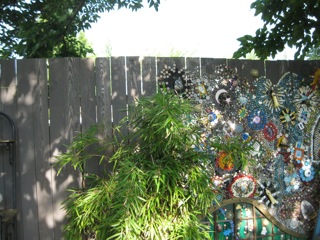
Be sure to notice her personalized window boxes, many ceramic and clay masks, and the large mosaic on the back fence that has a story that Wendy will tell you about.WE3

Her garden has many peonies, rhododendrons, wisteria and perennials such as Erysimum Bowle’s Mauve, alyssum and dahlias. Notice the planter barrels next to the house with cut metal vines and leaves. There is so much more for you to discover!

Wendy has been described by her daughter-in-law as “the most persistently creative person I have ever met. Creating for Wendy is like breathing for other people, and every inch of space reflects this.”

Wendy’s garden is a hidden treasure.
~Karen O’Rourke

*Wendy asked that we not put up our AGC sign honoring her garden.

Horticulture Report: May 2013

Rhododendrons & Azaleas
What’s the difference between Rhododendrons and azaleas?

Azaleas are Rhododendrons. They belong to the subgenus pentanthera (deciduous) and the subgenus Tsustusti (mostly evergreen).
Azaleas are elepidotes, they never have scales.
Azaleas have five lobes to the flower.
Most azaleas have only one stamen for each lobe of the flower, while most other rhododendrons have two stamens for each lobe.
Azaleas tend to have appressed hairs (hairs that grow parallel to the surface of the leaf). This is particularly true along the midrib of the under-surface of the leaf and is easily seen in the so called “evergreen” azaleas.
Azaleas have tubular funnel or funnel shaped flowers. You need a microscope to see this, but the hair on a “standard” rhododendron will often branch, while the hair on azaleas never does.

Basic Needs:
Rhododendrons must have a constant supply of moisture.
They are sensitive to poorly drained conditions.
Hot wet conditions are more dangerous than cool, wet conditions.
They need an acid soil of pH 5-6.
Fertilizer: A 10-6-4 formula is optimal. For the best growth and flowers apply fertilizer after the plant goes dormant between late Nov and Jan, a second application in Feb or March, a third time in April or May, and a final time in June or July.

Pruning:
Always prune right after flowering. Even large plants can be cut back. Rhododendrons & azaleas flower on the prior year’s wood, therefore the buds for next spring’s flowers form during the previous summer or fall. If you prune them later in the summer, fall or winter you will be trimming off your flowers for the spring.
Prune larger leaved rhododendrons just above the growth joints.
Prune azaleas and small leafed rhododendrons anywhere along the stem. These plants have dormant growth buds nearly everywhere, though you may not be able to see them.

Deadheading and Pinching:
Light pruning and shaping should be done yearly when you deadhead. Snap off the old flower trusses. You may pinch out the single terminal growth buds just as they start to grow. It will make a shorter and bushier plant.

For more information:
American Rhododendron Society
http://www.rhododendron.org/

American Azalea Society
http://azaleas.org/

Definitions:
Elepidotes are large leaved rhododendrons. They are the type of shrub that most individuals would associate as being a rhododendron. They do not have scales located on the underside of the leaves. Plants tend to be very large in their maturity.

Lepidote rhododendron have smaller leaves and are usually low growing or dwarfs. They usually bloom earlier in the spring than the larger leaved elepidotes. Tiny scales cover the undersides of the leaves of some rhododendron species.